
Can Your Hospitality Business Function Without You in the Room?
When every question, decision and crisis lands on your shoulders, dedication quietly turns into dependency
Most hospitality owners don’t set out to build a prison for themselves.
It happens in tiny, reasonable steps.
A line cook calls in sick, so you step in to flip burgers. A delivery arrives half-empty, so you chase the supplier. The POS terminal crashes, a guest complains, the kitchen falls behind—and every head in the room turns in your direction.
You solve the problem. Of course you do.
That’s what real operators do.
But repeat this scenario often enough and a subtle shift occurs inside your business.
Your team stops making decisions without your blessing. Problems sit on hold until you walk through the door. Standards remain razor-sharp while you are watching but begin to slip the moment you turn your back.
To an outsider, this looks like brilliant, hands-on leadership.
From inside, it feels like you can never truly leave. You can’t switch off. You can’t get sick. Even stepping away for a quiet Sunday afternoon means a steady stream of text messages, phone calls and the lingering dread that you’ll return to a list of preventable fires.
The question isn’t whether your venue needs leadership. Of course it does.
The question is:
Has your leadership quietly become the business’s life-support system?
It Always Starts With Good Intentions
In a restaurant, decisions can rarely wait for a meeting next Tuesday.
The queue is building now.
Table 4 has been waiting for drinks now.
The new waiter needs an answer right now.
So the most experienced person in the building steps in—because it’s faster.
Experienced owner steps in → Problem solved in ten seconds → Staff learn to wait → More decisions are escalated → The owner becomes the bottleneck
At first, this makes total sense. You protect the guest experience and keep the shift moving.
The problem begins when stepping in becomes the normal way your business operates.
Your team learns a silent, unintended lesson:
When things get tricky, don’t think. Just wait for the boss.
This isn’t necessarily laziness. More often than not, staff have learned that making an independent decision carries a risk.
Maybe someone was yelled at last month for taking initiative. Maybe two managers gave conflicting instructions. Or perhaps the official manual says one thing while you silently expect another.
So people become careful.
They cover themselves.
They ask permission for everything.
They wait.
Meanwhile, you look at them waiting and conclude:
“Nobody around here takes any responsibility.”
Both sides become deeply frustrated, and the dependency continues to grow.
The Senior Anchor Trap
I call this the Senior Anchor: the person whose constant presence holds the shift together but whose total involvement prevents the operation from learning how to move without them.
The anchor is usually the owner, but it can just as easily be a general manager, head chef or one long-serving employee who knows how things are really done.
This person holds all the operational knowledge in their head:
- The direct mobile number for the emergency plumber.
- The strange trick that restarts the coffee machine when it freezes.
- Which regular guest always wants their dressing on the side.
- Where the spare keys are hidden.
- How to calm the kitchen when ticket times go beyond 20 minutes.
That knowledge is extremely valuable.
But when it exists only inside one person’s head, their absence becomes a serious operational risk.
When one person becomes the answer to every daily question, you haven’t built a dependable system. You have created a single point of failure.
Then that person gets the flu, takes a holiday or simply burns out.
Suddenly, the entire operation begins to stall.
5 Signs Your Business Cannot Let You Go
- Your Phone Never Really Stops Ringing
You might be at a family dinner or sitting on a beach, but you aren’t actually off duty.
Staff call you about €10 discounts, minor guest complaints, missing stock or basic shift changes—decisions they should reasonably be able to handle themselves.
One call is an exception.
Ten calls mean authority never left your pocket.
- Standards Evaporate the Second You Walk Out
When you’re on the floor, tables are wiped, orders move and small details get noticed.
The moment you leave, the energy drops, the music gets strange and service becomes sluggish.
That gap tells you that your standards are tied to your physical presence rather than built into the way the operation works.
- Problems Arrive Without Solutions Attached
You constantly hear:
“This is broken. What should I do?”
There will always be decisions that require senior approval. But if every minor problem travels directly to you without even a proposed solution, your team either lacks clear decision-making boundaries or doesn’t feel safe using its own judgement.
- You Are Secretly Working Five Jobs at Once
You’re handling stock control, fixing the ice machine, chasing invoices, running food and balancing the till.
Being capable of doing every job is part of hands-on leadership.
Having to do every job just to keep the doors open is a serious warning.
- Time Away Causes Panic Instead of Rest
Can you turn off your phone for 24 hours without feeling a knot in your stomach?
If taking one week away requires two months of frantic preparation, your business is telling you that it doesn’t yet know how to function without you.
This Is Rarely Just a Staffing Problem
It is very easy to throw your hands up and complain:
“Good staff are impossible to find.”
Sometimes an individual employee is genuinely lazy, unreliable or simply wrong for the role.
But if three different managers make exactly the same mistakes, we have to stop blaming the people long enough to examine the operation.
Something in the way the business is organised may be teaching people to behave this way.
Ask yourself the uncomfortable questions:
- What exact amount can a manager spend to resolve a guest complaint without calling you?
- Do your shift supervisors give conflicting instructions when you aren’t present?
- Can a new waiter find the stock list in under ten seconds during a busy service?
- What happens when an employee takes initiative and gets something slightly wrong?
- Do you coach them, or do you tear the decision out of their hands and take control again?
If your operational boundaries are unclear, people will either guess or freeze.
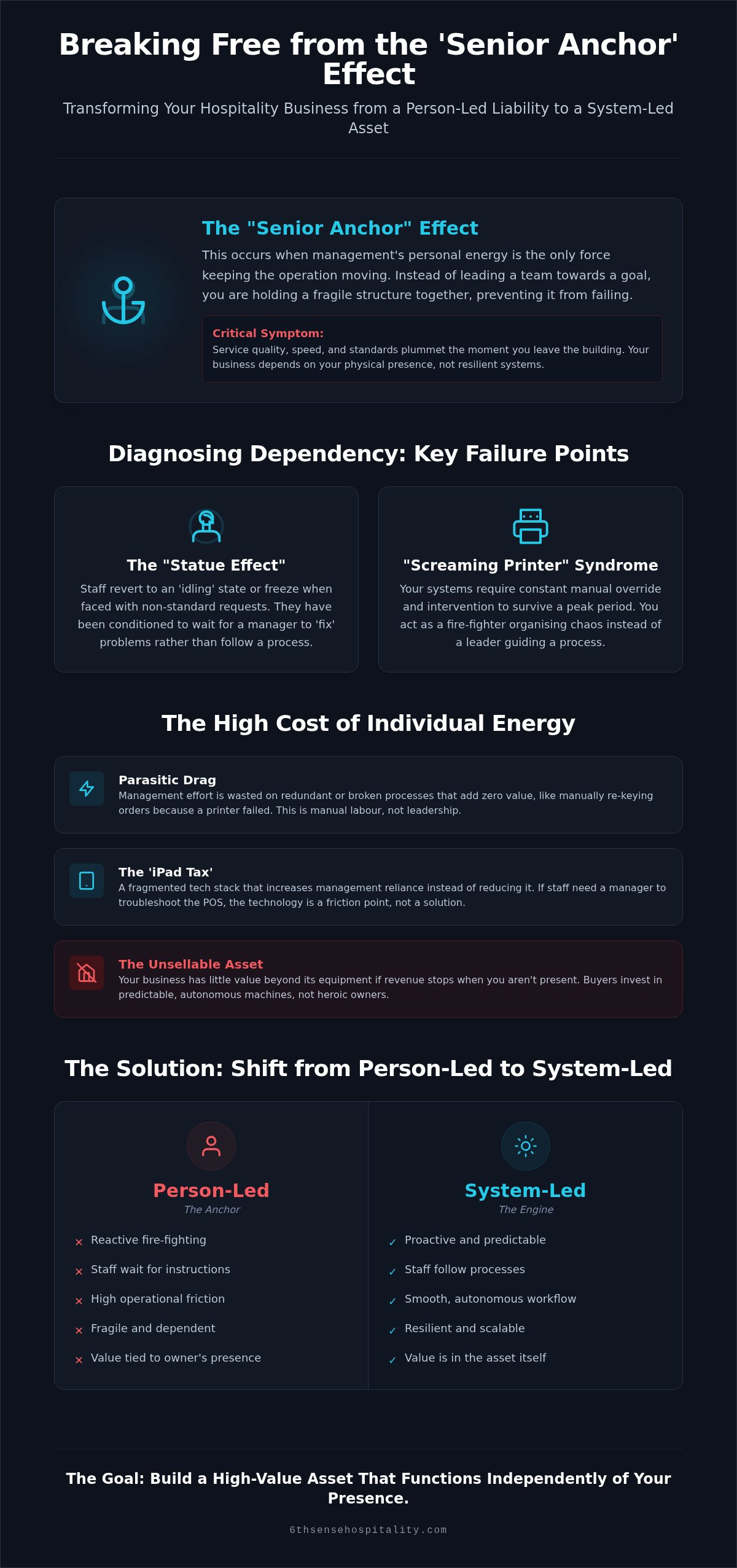
Most choose to freeze because waiting for the boss feels safer than making the wrong decision.
Blaming lazy staff may feel comforting in the moment, but it will never set you free.
Leadership and Dependency Are Not the Same Thing
Let’s be crystal clear: a great hospitality business will never run entirely on autopilot.
You shouldn’t want it to.
Leadership sets the direction, protects standards, develops people and watches the margins.
Healthy leadership creates clarity.
Structural dependency concentrates every routine decision inside one tired brain.
The goal isn’t to make you irrelevant.
The goal is to make your time dramatically more valuable.
You should be spending your energy on menu strategy, margins, marketing, supplier negotiations and the future of the business—not spending twenty minutes searching for the spare keys to the drinks store.
The real test is simple:
«Are you actively leading the business, or are you physically carrying it on your back?»
How to Break the Cycle Without Lowering Your Standards
Step 1: Audit Your Daily Interruptions
For seven straight days, keep a small notepad in your pocket.
Every time an employee interrupts you with a question or problem, write it down.
Don’t judge the question. Don’t blame the employee. Just record it.
At the end of the week, look at the list.
You will begin to see patterns. You’ll see where information is missing, authority is unclear or training has failed to survive contact with a real shift.
Repeated questions are rarely random.
They show you where the operation keeps sending responsibility back to you.
Step 2: Draw Clear Decision Boundaries
Your team needs to know exactly how far its authority extends before an issue must be escalated.
For example:
- Front-line staff can resolve a minor guest problem within an agreed limit.
- Floor supervisors can spend up to €30 to solve a guest complaint immediately.
- Head bartenders can temporarily remove an unavailable product from the POS.
- Shift managers can contact approved suppliers when essential stock is missing.
- The owner retains decisions involving strategy, margins, major spending and permanent menu changes.
The exact figures will depend on your business.
The important thing is that the boundaries are clear.
Clear boundaries do not create chaos.
They prevent unnecessary phone calls while protecting the decisions that genuinely belong to you.
Step 3: Put Knowledge Where the Work Happens
A 60-page PDF manual locked inside a back-office drawer is useless during a Friday night rush.
Put important information at the point where your team needs it:
- A laminated four-step guide beside the coffee machine reset switch.
- A clear opening and closing checklist beside the POS screen.
- A one-page emergency supplier contact list inside the stockroom door.
- A simple guide explaining who can resolve which guest complaints.
- Clear stock levels and reorder responsibilities.
The best operational tool isn’t the most detailed one.
It is the one your team can understand and use while the tickets are still printing.
Step 4: Let People Make Controlled Decisions
You cannot ask people to take responsibility and then punish them every time their decision differs from the one you would have made.
Give staff room to make decisions within clearly defined limits.
When they get something wrong, review it afterwards. Correct what needs correcting, but explain why.
If every imperfect decision causes you to take back control, the team learns that initiative is dangerous.
Responsibility grows through use.
The goal is not instant perfection. It is a team that becomes more capable each time the operation tests it.
Step 5: Test Your Absence Deliberately
Don’t wait for illness or a family emergency to discover whether your business can function without you.
Plan an absence.
Step away for an entire shift. Make it absolutely clear who is in charge, which decisions that person can make and what genuinely warrants a phone call.
When you return, don’t conduct an interrogation.
Conduct an honest review:
- Where did the workflow slow down?
- What information was missing?
- Which decision came back to you?
- Why couldn’t the team or the existing system answer it?
- What needs to change before the next test?
Every deliberate absence should remove one more reason the business cannot function without you.
You Are Still Needed—Just Not for Everything
Many owners fear that stepping back means lowering standards or losing control.
But carrying every decision personally is not control.
It is overload.
There is also a human cost.
When the business relies on your constant presence, rest begins to feel irresponsible. Family time gets interrupted. Illness becomes a commercial threat.
Eventually, even the work you once loved can begin to feel like confinement.
This is not a lecture about working less.
Hospitality sometimes demands long days, immediate decisions and visible leadership. Anyone who has worked inside a real operation knows that.
There will always be moments when the owner has to jump behind the bar, help at the pass, speak to an angry guest or rescue a difficult shift.
But there is a difference between stepping in because the moment requires you and building an operation that requires you every moment.
Your experience should guide the business.
It should not be the only thing holding it together.
The One Question That Exposes Everything
If you turned off your phone and walked away from your business for seven full days, what would stop functioning first?
Not what would look slightly less tidy.
Not what someone might do differently from you.
What would come to a complete stop?
Whatever your answer is, that is your starting point.
Frequently Asked Questions
What Does Owner Dependency Look Like in Practice?
It means the daily momentum of the business relies too heavily on one person being present.
When that person leaves, decisions stall, routine questions go unanswered and operational standards begin to slide.
Is Owner Dependency Caused by Hiring Bad Employees?
Not usually.
Bad hires certainly happen, but repeated dependency is more often caused by unclear decision boundaries, inaccessible information, conflicting instructions or a culture in which staff are punished for taking initiative.
Will Giving Staff More Authority Lower My Standards?
Not when authority comes with clear financial and operational boundaries.
Giving employees controlled authority helps them build competence. Withholding all authority forces them to remain completely dependent on you.
Can a Hospitality Business Really Function Without Its Owner?
It should be able to handle normal daily operations without the owner making every routine decision.
That doesn’t mean leadership is unnecessary. It means responsibilities, standards and escalation routes are clear enough for the team to continue operating when the owner is not physically present.
Where Should I Start if I Want to Reduce Owner Dependency?
Track every question, interruption and problem brought to you over a five-to-seven-day period.
Group the repeated issues. Choose the most common one and create a clear rule, checklist or decision boundary for it.
Then give the appropriate person the authority to handle it.
Ready to See How Heavily Your Business Relies on You?
Stop carrying the weight of every minor decision on your own shoulders.
Take the Senior Anchor Quick Scan for €7 and identify where your business may be relying too heavily on your presence.
If you walked away from your operation for a full week starting right now, what is the very first thing that would break?


