
Where Hospitality Businesses Really Start to Break
Why does a restaurant—or a café, or a hotel—start to crumble?
It’s almost never a massive explosion. You don’t wake up on Tuesday morning to find the building has magically collapsed into a pile of rubble.
No. It happens in whispers.
A running hot-water tap that nobody bothers to turn off completely. A waiter who invents his own bizarre method for stacking side plates. An owner who answers the exact same question for the fourth time before noon. A shiny new app bought to solve one tiny headache, which promptly creates three brand-new ones.
At the end of a chaotic weekend, the till says you hit record turnover. But when you look at the bank account?
There’s almost nothing left.
Individually, these little quirks don’t seem like a big deal. You shrug. You work around them. But put them together, and they tell a completely different story.
They are hospitality business stress points—the exact spots where your time, your cash and your sanity leak out of the building.
And the scariest part?
Once a workaround becomes routine, it stops looking like a problem. It just becomes “the way we do things here.”
That’s where the real danger lives.
The Illusion of the “Busy” Room
Walk into a dining room on a Friday night.
The terrace is packed. The bar is four-deep. The kitchen printer is spitting out tickets like a hyperactive slot machine.
Looks healthy, right?
Not so fast.
Movement isn’t performance. And turnover is definitely not profit.
A business can easily be slammed while quietly bleeding to death. It can employ brilliant people who look utterly clueless the second a rush hits. It can pay for six different software subscriptions while the kitchen staff still yell order changes across a noisy line.
So don’t ask yourself, “Are we busy?”
Ask the question that actually matters:
What happens to this business when the pressure hits maximum?
Because quiet times are dirty liars.
When it’s slow, your team has time to fix a botched order. Someone can stroll to the dry store to grab a forgotten bag of flour. The manager can step in, play hero and charm an unhappy guest. These tiny interventions hide your system’s structural flaws.
Peak service rips off the bandage.
When the floor is jammed, every extra step costs you money. Every vague instruction turns into a bottleneck. Staff start throwing questions at you faster than you can dodge them.
And if you assume it’s just a “staffing problem,” you’re in trouble.
Blame the person instead of the broken system and you’ll fire the employee, hire a new one and watch the exact same mess unfold all over again.
The Five Hidden Leaks Draining Your Operation
These five hospitality business stress points don’t live in isolated boxes. They feed on each other.
- The Workflow: effort disappears.
- The Information: guesswork begins—and creates the Statue Effect.
- The Margin: busy service hides invisible leaks.
- The People: messy workarounds create the Senior Anchor.
- The Owner: every exception gets squeezed through the Bottlecap.
One stress point pushes pressure into the next.
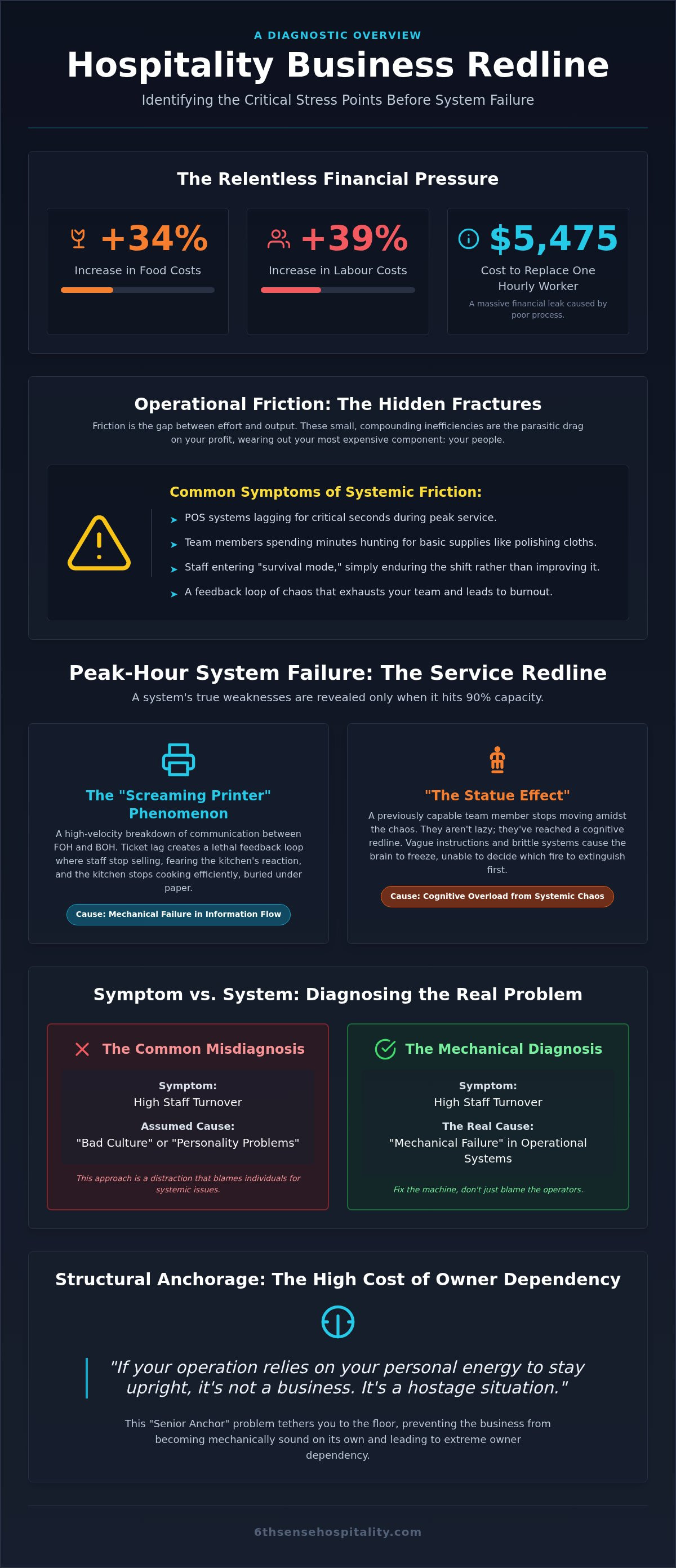
What looks like a slow employee may have started with a badly designed service station. What looks like high labour cost may have started with a menu that demands too many hands. What looks like an exhausted owner may actually be a business with nowhere else for decisions to go.
Let’s follow the leaks.
- The Workflow: Where Effort Disappears
Workflow is simply the path an order takes from the moment a guest opens their mouth to the moment they take their first bite.
Watch your team. Really watch them during a rush.
Is a runner walking back and forth across the entire floor just to fetch cut-lemon wedges? Is an order being typed into the POS once, then handwritten on a kitchen ticket anyway? Is someone opening three refrigerators to assemble one drink? Are finished plates waiting because nobody clearly owns the final handover?
A tiny 15-second detour doesn’t look catastrophic. That’s why it survives.
But multiply that detour by 150 orders a night and you’ve burned hours of paid labour on useless motion.
The dangerous mistake is to write a new rule before watching what actually happens. The official workflow may look perfect on paper. Your staff’s feet will tell you the truth.
Follow the movement. Count the steps. Notice what people repeatedly leave their stations to find.
That’s where effort is disappearing.
- The Information: Where People Freeze
When clear information is missing, humans guess.
One server asks. Another assumes. A third just stands there.
This brings us straight to the Statue Effect.
Have you ever seen a completely capable employee stand frozen in the middle of a chaotic shift? It’s easy to call them lazy, slow or useless. But often the system has slammed them with four competing priorities and given them zero guidance on what to do first.
The kitchen needs an answer. A guest is waiting. The card terminal has stopped working. Two plates are ready to run. Everybody appears to be shouting their problem at the same time.
Which fire comes first?
If the system doesn’t answer that question, the employee has to guess.
They aren’t standing still because they don’t care. They’re standing still because the operation has overloaded them without providing a clear priority.
And while they guess, your money walks out the door.
Orders are delayed. Items are made twice. Guests stop ordering another round. Managers abandon their own positions to rescue preventable situations.
Clear instructions matter—but instructions alone are not enough. The right information must reach the right person, in a form they understand, at the moment they need it.
If your team starts guessing, the money has already left the building.
- The Margin: Where Busy Hides the Truth
Margins don’t usually collapse from one giant mistake. They leak through a thousand tiny, boring decisions:
- Portions slowly creeping up because nobody uses a scale or portion measure.
- Menu items priced from memory instead of current supplier invoices.
- Takeaway packaging never included in the dish cost.
- Freebies handed to regulars without being recorded through the till.
- A popular item occupying a key station for too long.
- A garnish added for appearance but never added to the calculation.
- Paid hours spent correcting mistakes the workflow created.
None of these leaks looks dramatic on its own.
Together, they can destroy the value of a busy service.
Even an exceptionally lean labour percentage cannot rescue a menu with weak base economics. If the product itself is underpriced, over-portioned or unnecessarily complicated to produce, selling more of it may simply accelerate the loss.
That is why the till can celebrate while the bank account sits in the corner looking miserable.
The question is not only, “How much did we sell?”
It is:
What did it take to produce those sales—and what remained afterwards?
Turnover tells you how much money entered the building. It does not tell you how much escaped through the back door.
- The People: The Senior Anchor Trap
When good people are placed inside a messy system, they invent workarounds to survive.
At first, this looks useful. Someone figures out which button to press when the POS freezes. Someone remembers that the extra stock is hidden in the second storeroom. Someone knows which supplier must be called directly because emails are never answered.
Eventually, one superstar employee learns how to navigate the whole mess.
They become the Senior Anchor.
They hold the operational secrets in their head. The floor runs smoothly—but only when they are on shift. New employees don’t learn the system; they learn to ask the Senior Anchor. Managers don’t remove the workaround because the Senior Anchor makes it work.
Then one Saturday they call in sick.
The shift collapses like a house of cards.
Relying on heroics isn’t a strategy. It’s an operational risk.
Capture what your best people know. Turn their judgement into clear triggers, their routines into visible processes and their solutions into knowledge the rest of the team can use.
The goal is not to make experienced people less important. It is to stop the business from becoming helpless without them.
- The Owner: The Bottlecap
“Where do we keep the extra napkins?”
“Can you approve this refund?”
“What should I tell this customer?”
“Are we allowed to substitute this item?”
It’s always faster for you to answer the question yourself than to fix the system that caused it.
So you answer it.
Then you answer another one. And another.
Congratulations: you have just turned yourself into the business’s central emergency switchboard.
This is the Bottlecap.
Every question, exception and decision is forced through one narrow opening: you. The team may contain capable people, but responsibility cannot flow around you. Everything queues at the top of the bottle waiting for your attention.
If the entire operation grinds to a screeching halt the second you step out to grab a coffee, you don’t own an independent business. You own a high-stress babysitting service.
Answering every question may feel like control. It may even feel responsible. In reality, you are teaching the team that the safest decision is no decision until you arrive.
The owner should provide direction, standards and judgement. The owner should not have to provide the daily electricity that keeps every routine process alive.
The iPad Tax
Let’s talk about technology for a second.
Vendors love to promise that their shiny new app will magically fix your operation. But half the time, software simply moves your old operational chaos onto a screen.
We call this the iPad Tax.
It’s not just the subscription fee. It’s the hidden cost of setup, training, forgotten passwords, manual re-entry and staff jumping between three different apps that refuse to speak to each other.
Before adding another tool, ask:
- Which manual step does this remove?
- Which mistake does it prevent?
- Which decision becomes faster?
- Who must maintain it?
- Does it still work when the operation is busy?
- What happens when it fails?
If a digital tool doesn’t eliminate a manual step, cut a delay or prevent a mistake, it’s just expensive digital decoration.
Technology should carry weight. It should not become another thing your team has to carry.
How to Audit Your Stress Points Without Going Crazy
You don’t need a 300-page manual to begin fixing this.
You just need to look closer.
Track One Order
Pick a standard coffee, cocktail or burger order during a peak rush. Trace its entire journey. Count every step, screen, handover, question and correction required to fulfil it.
Do not trace the process you designed. Trace the process people actually use.
Log the Questions
For five days, write down every interruption or question brought to you. Don’t rely on memory. At the end of the week, group them.
Repeated questions reveal missing information, unclear authority or a process that exists only inside your head.
Find the Hidden Workarounds
Ask your cooks, bartenders and service team what they do when the official process doesn’t work.
Don’t punish them for breaking the rules. Thank them for showing you where the system failed.
Then decide whether the workaround should become the new process—or whether the original problem must be removed.
Follow the Money Backwards
Choose one popular product and calculate more than its ingredient cost. Include preparation time, packaging, waste, garnishes, production difficulty and the station capacity it consumes during peak service.
A bestseller is not automatically a good product.
Test True Independence
Step away for four hours during a routine shift. Don’t answer non-emergency calls. See what breaks first.
The first question that cannot be answered, the first decision that cannot be made and the first process that stops without you—that is your starting line.
Fix the Cause, Not the Symptom
When you see a slow server, the knee-jerk reaction is to yell about hustle.
But look closer. Maybe the service station is laid out like a maze.
When you see ballooning labour costs, it’s easy to cut hours.
But look closer. Maybe your menu requires eight minutes of knife preparation for a plate that sells for peanuts.
When employees keep asking the same question, it’s tempting to tell them to use common sense.
But look closer. Maybe two managers gave them two completely different answers yesterday.
Stop fighting the symptoms.
Find the single point of failure creating the most friction. Trace it back to its root cause. Then fix the structure.
You don’t need to repair the entire business in one weekend. Start with the stress point that repeatedly consumes the most time, money or management attention.
Make one change. Test it under real pressure. Watch what improves—and what the change exposes next.
That is how an operation becomes stronger: not through another motivational speech, but through clarity about what is actually happening.
Frequently Asked Questions
What Exactly Is a Hospitality Business Stress Point?
It’s any specific point in your operation where information, money, effort or momentum gets stuck. It usually appears as repeated delays, employee guesswork, constant manager interruptions, unnecessary movement or missing profit.
How Can a Business Be Slammed With Customers and Still Lose Money?
High sales can conceal waste, slow preparation, uncalculated packaging, excessive labour and weak menu margins. If the base economics are wrong, more volume simply accelerates the rate at which the business loses money.
What Is the Statue Effect?
The Statue Effect is when an otherwise capable employee freezes during a rush because the operation has given them multiple competing tasks without a clear priority. What looks like laziness may actually be overload and uncertainty.
What Is the Senior Anchor Problem?
It happens when one key employee carries essential operational knowledge in their head. The shift relies on that person’s memory and workarounds instead of a visible, repeatable system.
What Is the Bottlecap?
The Bottlecap is the owner or manager through whom every question, exception and decision must pass. It creates a narrow point that restricts the whole operation and prevents the team from functioning independently.
What Is the iPad Tax?
The iPad Tax is the total hidden waste—time, labour, subscriptions and frustration—caused by digital tools that add administrative work without removing meaningful manual work.
Where Should I Begin?
Start with the shift or process that takes the most out of you to keep running. Track one order, record repeated questions and identify the first point where the workflow becomes unclear.
That is usually where the real repair begins.
Ready to Find Out Where Your Operation Is Leaking Cash?
You don’t need a months-long consulting contract or a bloated 80-page report to figure out what’s broken.
You need to know which stress point is putting the greatest pressure on everything else.
Run the 60-second Quick Scan for €7 and pinpoint the stress point choking your business today.
And before you move on, answer one honest question:
Which specific shift or process in your operation currently takes the most out of you to keep running?


