
Your team is capable. You hired for talent and trained for skill. Yet, under pressure, the system stalls. Instructions get lost, service slows, and margins you fought for evaporate in the heat of a busy service. You feel like the only person holding it all together, and performance drops the moment you’re not physically directing traffic.
This isn’t a people problem. It’s a mechanical failure.
Stop trying to fix your staff and start diagnosing the machine they operate in. This is about identifying the specific points of operational friction—the hidden system flaws that cause even your best people to grind to a halt. It’s about moving from guesswork and frustration to data-driven clarity on where, and why, your operation is shearing under pressure.
The Mechanics of Operational Drift: Why Performance Shears
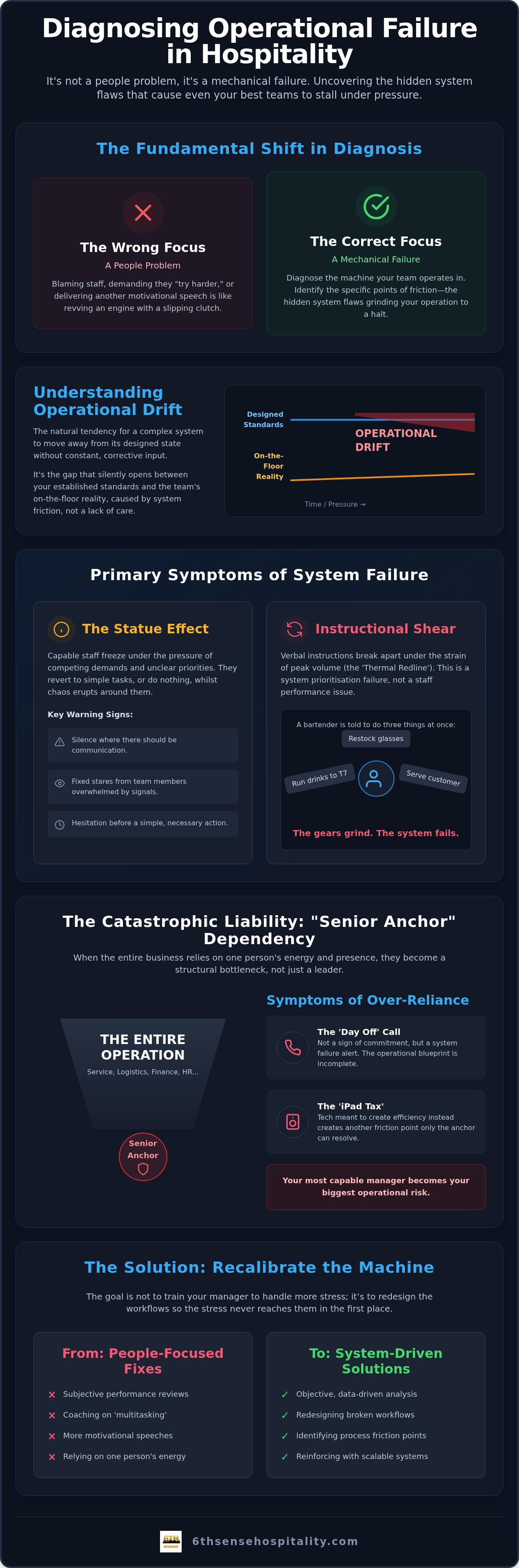
You’ve felt it. That slow, silent decay of standards when direct oversight is removed. It’s not insubordination; it’s a systemic issue called Operational Drift. This is the natural tendency for a complex system to move away from its designed state without constant, corrective input. In a restaurant, it’s the gap that opens between your standards and the team’s on-the-floor reality.
This drift isn’t caused by a lack of care. It’s caused by friction. When the gap between expectation and execution widens, instructions begin to “shear”—they break apart under the strain of real-world conditions. A perfectly clear order in a quiet pre-shift briefing becomes ambiguous noise during a chaotic Friday night peak. At this point, “trying harder” or delivering another motivational speech is like revving an engine with a slipping clutch. You’re generating heat and noise, but no forward motion.
The Statue Effect: Diagnosing the Silence
The most dangerous symptom of this drift is the Statue Effect. This is not about staff being lazy or inactive when you are absent. It’s what happens when capable, well-intentioned employees freeze under the pressure of competing demands and unclear priorities. They are caught between multiple instructions, unsure which task takes precedence, and the safest option becomes to do nothing at all, or to revert to a single, simple task whilst chaos erupts around them.
You’ll recognise it in the sensory details: the silence where there should be communication, the fixed stare of a team member overwhelmed by conflicting signals, the hesitation before a simple action. They aren’t ignoring you; the system is giving them too many signals at once. The Statue Effect is the primary symptom of a system where instructions lack a clear mechanical linkage to priorities, forcing your team to guess. And as we've covered before, when your team starts guessing, the money has already left the building.
Instructional Shear: Where the Gears Grind
Verbal instructions are the weakest part of any operational machine, especially when it’s running hot. During peak volume—what we call the Thermal Redline—the capacity for your team to absorb, prioritise, and execute verbal commands plummets. This is where instructional shear occurs.
This is a process friction point, not a people problem. If a bartender is told to restock glasses, serve a customer at the bar, and run drinks to table seven all at once, they don’t have a performance issue; they have a prioritisation failure in the system. The instructions have sheared. The gears are grinding because the system has demanded they turn in three different directions simultaneously. The solution isn’t to coach the bartender on multitasking; it’s to fix the broken workflow that created the conflict.
Diagnosing the “Senior Anchor” Dependency
In many restaurants, the entire operational structure is held up by one person’s energy. This individual—often the owner or a veteran manager—is the Senior Anchor. They are the human processing unit for the entire business, constantly translating chaotic inputs into clear instructions, absorbing pressure, and single-handedly preventing operational crashes.
This "hero management" is a catastrophic liability. The business becomes entirely dependent on that person's presence and energy levels. The hidden cost is immense: innovation stalls because the anchor is too busy firefighting, other managers never learn to make high-stakes decisions, and the system has no resilience. The anchor isn’t just a leader; they are a structural bottleneck, and the psychological toll on the person acting as the main support beam for their own business leads directly to burnout.
Symptoms of Management Over-Reliance
The signs of a Senior Anchor dependency are often mistaken for dedication. A phone call on your day off isn’t a sign of a committed team; it’s the first alert of a system failure. It means the operational blueprint is incomplete, forcing staff to seek manual overrides from the anchor for routine problems.
Another symptom is the "iPad Tax"—the hidden drag caused by overly complex or poorly integrated technology. When a manager has to spend their peak-hour focus wrestling with a POS system or delivery tablet integration, they are not managing the floor. The tech, meant to create efficiency, instead creates another pressure point that only the anchor knows how to resolve. Ironically, your most experienced and capable staff member can become your biggest operational risk, because the system has been built around their personal capacity, not scalable processes.
The Diagnostic Shift: From People to Systems
To fix this, you must shift your focus from coaching people to realigning the gears of the machine. The goal is not to train your manager to handle more stress; it’s to redesign the workflows so the stress never reaches them in the first place. This requires a move away from subjective performance reviews and towards objective, data-driven analysis.
Auditing management behaviour shouldn't be confrontational. It’s a diagnostic process. By analysing where a manager is forced to intervene, you can identify the broken parts of the system they are constantly patching. Using data-driven reality scores from diagnostic scans gives you a non-personal, factual basis for these conversations. It’s not about blame; it’s about identifying the load-bearing walls and reinforcing them with systems, not just one person’s energy. For a deeper look at this dependency, our guide on assessing operational reliance on management provides a clear framework.
Diagnostic Tools vs. Traditional Hospitality Consulting
When faced with performance issues, the default move is often to hire a hospitality consultant. This traditional approach involves weeks of observation, lengthy reports, and often, a five-figure invoice. The focus is frequently on abstract concepts like "culture" and "leadership," delivering corporate polish and motivational fluff that rarely survives contact with a Saturday night service.
A high-velocity diagnostic scan is the antidote. Instead of a 60-day project, a 60-second digital scan can identify a specific point of mechanical failure. For a cost of €7, you get objective data on a single, critical issue, versus a £5,000 retainer for subjective observations. A human consultant sees what your team performs for them; a digital diagnostic tool analyses the raw output of your system, revealing the friction points that are hidden from view.
Feature
Diagnostic Scans (6th Sense)
Traditional Consulting
Speed
60-second data capture, immediate results.
Weeks or months of observation and reporting.
Cost
Low-friction, single-digit entry point (€7).
High-cost retainers, often thousands of pounds.
Focus
Mechanical & systemic. Identifies specific friction points.
Cultural & behavioural. Focuses on "soft skills" and leadership.
Output
Objective, data-driven report on a single variable.
Subjective, long-form report with broad recommendations.
Actionability
Immediate, targeted realignment of a specific process.
Long-term implementation plans, often requiring more investment.
The Fluff Filter: Rejecting Corporate Polish
Talk about "improving company culture" is often a convenient distraction from the reality of a broken workflow. No amount of team-building can fix a system where the kitchen printer screams out incoherent orders during peak service. These are "Screaming Printer" moments—acute, high-stress equipment or process failures that generic audits and checklists completely miss. They don’t account for the reality of peak-hour pressure. A consultant’s checklist might say "ensure clear communication," but it won't diagnose that the root cause of the chaos is a thermal paper jam at 8 PM on a Friday.
High-Friction vs. Low-Friction Assessments
Traditional methods like mystery shopping are high-friction and provide lagging indicators. They tell you that a guest had a bad experience after the money has already left your business. It’s a reactive autopsy of a failure that has already occurred.
Operational diagnostics provide leading indicators. They analyse the internal mechanics of your operation to predict and prevent failures before they impact the guest. A Quick Scan gives you an immediate return on your investment by showing you precisely where the system is about to break, allowing a stressed operator to apply a precise fix, rather than a hopeful guess.
A Step-by-Step Framework for Performance Diagnosis
Moving from chaos to control requires a methodical approach. Instead of reacting to every fire, you need a repeatable framework for diagnosing the root cause of performance issues. This is how you shift from being the system’s operator to its engineer.
- Isolate the Symptom: First, identify the most critical failure point. Is it a margin leak where profits disappear despite high turnover? Is it a speed bottleneck in the kitchen pass? Or is it a management stall, where the team freezes without direct input? Don’t try to fix everything at once. Focus on the one gear that is stalling the entire machine.
- Deploy the Diagnostic: Once you have isolated the symptom, run a targeted 60-second Quick Scan designed to measure that specific friction point. If the team stalls under pressure, the Statue Effect scan is your tool. If margins are the issue, deploy the Evaporating Margin scan. This is about using the right instrument for a precise measurement.
- Analyse the Data: The scan will provide a raw, unfiltered reality score. This isn’t about opinions or feelings; it’s a hard number that shows you the gap between your intended process and what’s actually happening. Look for the patterns. Is there a consistent system lag at a specific time? Is there a clear point of hydraulic margin loss in your service sequence?
- Execute the Realignment: With clear data, you can now execute a precise mechanical realignment. This is not about retraining a person; it's about re-engineering the process. If the data shows a bottleneck, you adjust the workflow. If it shows instructions are shearing, you clarify the system of prioritisation. You fix the machine, not the ghost in it.
Step 1: Identifying the Pressure Point
The first step is to differentiate between "noisy" problems and "structural" problems. A noisy problem is a one-off issue, like a single staff complaint. A structural problem is a recurring failure pattern that points to a deeper flaw. Using a tool like the "Screaming Printer" scan helps you cut through the noise to find the epicentre of your peak-hour failures. By focusing on the one gear that is seizing up, you can apply your limited energy for maximum impact.
Step 2: The 60-Second Reality Check
The 60-second Quick Scan is your reality check. The Statue Effect Quick Scan, for example, measures the level of operational drift by analysing how clearly priorities are being executed under pressure. This process gathers raw data without the filter of polite management-speak or staff excuses. It prepares the team for a crucial cultural shift: moving away from rewarding "effort" and towards measuring "output." It’s not about how hard people are working; it’s about how effectively the system is translating that work into results.
Recalibrating the Machine: Beyond the Diagnosis
A diagnosis is only the first step. The ultimate goal is to use these data points to recalibrate your entire operational machine, building a business that runs itself without your constant manual input. The diagnostic results form the blueprint for your "Senior Anchor" exit strategy, showing you exactly which systems you need to build to replace your own personal energy.
This process involves systematically reducing parasitic drag—the small, cumulative inefficiencies from redundant processes, clunky tech, and ambiguous instructions that drain energy and profit. By creating clear Mechanical Linkages—unbreakable, system-enforced connections between tasks, priorities, and outcomes—you build a self-correcting system. The goal is to reach a state where you are monitoring the operational health score of your business, not personally managing its every function.
Unshackling the Owner
This is the path from manual management to systemic oversight. It’s about building a machine so well-engineered that your main role is to read the dashboard, not be one of the components. The 6th Sense diagnostic tools are designed to be your permanent mechanic, constantly monitoring the system for signs of drift and alerting you to pressure points before they become catastrophic failures. This allows you, the owner, to finally step away from the floor and focus on the bigger picture, confident that the machine will continue to run smoothly.
The €7 Fix: Immediate Operational Realignment
Your freedom starts with a single data point. The Statue Effect Quick Scan is the first, most critical step. For just €7, it provides an objective, immediate measurement of the instructional clarity within your team. It’s a small investment to diagnose the root cause of the stalls and freezes that are costing you revenue and burning you out.
Your diagnostic report will give you a clear, no-nonsense score, pinpointing where the operational friction is highest. It’s not another checklist or a vague recommendation; it’s the data you need to make your first mechanical realignment and begin the process of taking back your time and your business.
Diagnose your operational friction with the Statue Effect Quick Scan.
Frequently Asked Questions
How can I tell if my restaurant staff are underperforming when I am away?
Look for symptoms of system failure, not just individual laziness. These include a drop in average spend per head, an increase in voided orders, or a spike in negative online reviews mentioning speed or attentiveness. These are signs of Operational Drift, where the system itself is failing to maintain standards without direct oversight.
What is the Statue Effect in hospitality management?
The Statue Effect is what happens when capable staff freeze under the pressure of competing demands and unclear priorities. It is not about inactivity due to a lack of supervision, but rather a system-induced paralysis where employees are unsure which of their multiple tasks is most important, causing them to stall.
Why do restaurant managers become “Senior Anchors” for the business?
A manager becomes a Senior Anchor when the business's operational systems are incomplete or broken. They are forced to use their personal energy and experience to constantly patch holes, make judgement calls, and absorb pressure that a well-designed system would handle automatically. The business becomes dependent on them, making them a single point of failure.
Is mystery shopping the best way to diagnose staff performance issues?
No. Mystery shopping is a lagging indicator; it tells you about a problem after it has already affected a guest and your revenue. High-velocity diagnostic scans are leading indicators. They analyse the internal mechanics of your operation to identify stress points and predict failures before they happen, allowing you to be proactive instead of reactive.
How do I fix operational drift in my front-of-house team?
You fix it by reinforcing your systems, not by blaming your people. Start by diagnosing where instructions are shearing under pressure. Use a tool like the Statue Effect Quick Scan to get data on instructional clarity. Then, build clear, simple, and visually reinforced processes for key service points so that the "right way" is the easiest way, even during peak hours.
What are the most common restaurant revenue leakage points related to staff?
The most common leakage points are not theft, but system failures. These include "Hydraulic Margin Loss" from inconsistent portioning or pouring, missed upsell opportunities due to unclear priorities, and lost sales from slow table turns caused by bottlenecks in the service sequence. These are all symptoms of a machine operating with too much internal friction.
Can a 60-second scan really diagnose my restaurant’s problems?
A single 60-second scan won't diagnose every problem, but it can precisely diagnose one specific, critical failure point with data-driven accuracy. Instead of a broad, subjective report, you get a targeted, objective measurement of a key variable, allowing you to make one impactful, evidence-based change immediately.
How do I reduce my own dependency as an owner on daily operations?
You reduce your dependency by replacing your personal involvement with robust systems. Each time you are pulled in to solve a problem, ask "What system failed here?" and then build a process to prevent that failure from happening again. Use diagnostic tools to identify these failure points systematically, and build your exit strategy one system at a time.


