
When Your Team Starts Guessing, the Money Has Already Left the Building
Why restaurant staff instructions fail — and what the Statue Effect reveals about your operation
Your Restaurant Should Not Stop Working Because You Walked Out of the Room
There is a strange experiment you can perform in almost any restaurant.
Stand on the floor during a busy service.
Watch what happens.
People move. Decisions get made. Problems somehow find solutions.
Now disappear for twenty minutes.
Go into the office. Take a phone call. Check a delivery. Go outside.
And — this is important — don't answer the first call.
Then come back.
Sometimes it looks as if somebody pressed PAUSE.
A decision is waiting for you.
A delivery hasn't been put away because nobody knew where you wanted it.
A guest complaint has travelled through three members of staff without anybody actually solving it.
The kitchen is waiting for the floor.
The floor is waiting for the kitchen.
And somebody inevitably asks:
“Where have you been?”
As though you had taken the electricity with you.
I know this feeling very well.
After more than 30 years in hospitality, I have stood in that exact situation more times than I care to remember.
And the first reaction is normally frustration.
Why can't people just do what we've already discussed?
Why do I have to make every decision?
Why does everything seem to work when I'm standing here and start wobbling the moment I leave?
Fair questions.
But over the years I started asking myself another one.
What if the team isn't always waiting because they don't care?
What if, without realising it, we have created an operation that has trained people to wait for us?
That is what I call:
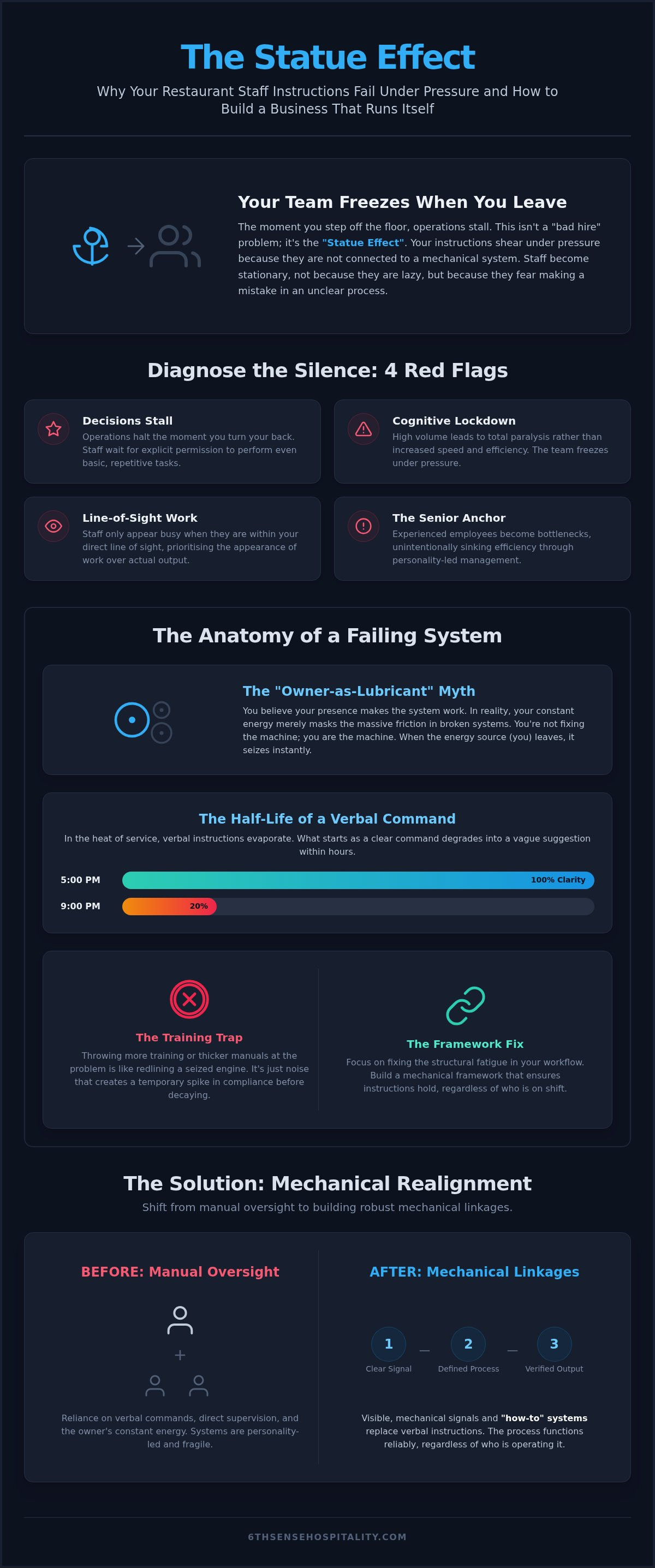
The Statue Effect
Imagine watching a football match where every player has to look at the coach before making the next move.
The striker gets the ball.
Looks at the bench.
“Shoot?”
The defender sees danger.
“Should I tackle?”
The goalkeeper catches the ball.
“Where should I throw it?”
You'd go mad watching it.
Yet look carefully at some restaurant operations and we do exactly this.
Table 14 wants to move.
Ask the manager.
A guest complains.
Ask the manager.
We're running low on glasses.
Ask the manager.
Can I comp this coffee?
Ask the manager.
Kitchen is getting buried.
Where's the boss?
Eventually the manager isn't managing anymore.
They're doing air-traffic control with a tray in their hand.
Everything comes through one person.
And the moment that person leaves?
The planes start circling.
That is the Statue Effect.
And there is a commercial consequence to it that we sometimes overlook:
If your team starts guessing, the money has already left the building.
Because guessing costs time.
Guessing produces mistakes.
Guessing creates unnecessary comps, duplicate work, delays, waste and frustrated guests.
Not every mistake is catastrophic.
But twenty tiny points of uncertainty during a busy service can quietly eat into the margin you worked all week to create.
Key Takeaways
By the end of this article, you should be able to recognise why restaurant staff instructions fail even when people have been trained, identify whether your operation depends too heavily on one owner or senior employee, spot processes that create hesitation instead of clarity, understand when technology is creating an iPad Tax, and test whether your team knows what to do when the pressure rises and you are not standing beside them.
Most importantly, this isn't about automatically blaming management or staff.
Sometimes you hired the wrong person.
Sometimes somebody simply didn't listen.
Sometimes the training wasn't good enough.
And sometimes the same problem appears with different people because the weakness is sitting somewhere in the system.
The skill is knowing which one you're looking at.
The Statue Effect: What Happens When You Walk Away?
You know the scene.
You leave the floor for ten minutes.
Maybe you go to the office.
Take a phone call.
Check a delivery.
Or, God forbid, try to sit down and eat something.
You come back and suddenly three decisions are waiting for you.
The kitchen pass is filling up.
Someone is looking for a key.
A customer has been waiting for an answer.
And a member of staff asks you something you've explained perhaps twenty times before.
And you think:
“What happened? I was gone for TEN minutes.”
I've experienced this myself.
The natural reaction is:
Why don't they listen?
Why can't they just get on with it?
Why do I have to be here for everything?
But here's the question that became more interesting to me:
Have we trained people how to work — or have we trained them to work when we're watching?
Those are two very different things.
A restaurant can look extremely well organised while the owner or strongest manager is present.
That doesn't necessarily mean the system works.
It may simply mean that one experienced person is filling every gap in real time.
They answer the question.
They notice the missing mise en place.
They move the waiter.
They fix the table plan.
They calm the kitchen.
They find the missing stock.
They make the judgement call.
Service survives.
Everybody goes home.
And because the evening survived, we tell ourselves the system worked.
Maybe it didn't.
Maybe you worked.
There is a difference.
Saturday Night Is the Crash Test
A procedure that works at 3pm on Tuesday hasn't proved very much.
Test it when the restaurant is full.
The printer doesn't stop.
Three tables arrive together.
Someone hasn't turned up for their shift.
The bar is three deep.
Table 12 wants to change their order.
A delivery is late.
And naturally, that's the exact moment the card terminal decides it also needs some attention.
That is your crash test.
Car manufacturers don't test safety systems by gently driving around a parking lot.
They put them under pressure.
Hospitality does exactly the same thing to our systems every Friday and Saturday night.
And that's often when restaurant staff instructions fail.
Something that sounded completely clear at 5pm can become a very different thing at 9pm.
Not necessarily because somebody is stupid.
Because they're hot.
They're tired.
They're distracted.
They're hearing the printer.
A guest is talking to them.
Somebody from the kitchen wants an answer.
They have six things in their head already.
And now your beautiful five-step procedure has to compete for seventh place.
That's why:
“Guys, we've spoken about this before...”
isn't always the solution we think it is.
Sometimes, absolutely, somebody needs correcting.
Sometimes you've simply hired the wrong person. That happens too.
But if different people repeatedly fail at exactly the same point, stop looking at the people for a moment.
Look at the system.
They Know What to Do. So Why Isn't It Happening?
This is one of the most frustrating things in hospitality.
You've trained them.
You've explained it.
They nod.
They understand.
You see them do it correctly.
Then Friday night arrives and suddenly it's gone.
So we do what hospitality managers have done forever.
Another meeting.
Another briefing.
Another WhatsApp message.
Another laminated sheet.
Another:
“Please, everybody, read this carefully.”
I've done it.
Most of us have.
But imagine pouring water into a bucket with holes in the bottom.
The water keeps disappearing.
So what do we do?
Pour faster?
At some point you have to stop pouring and find the holes.
Training matters. Of course it does.
But if the employee understands the instruction during training and repeatedly fails to execute it during service, I want to know where the instruction is leaking out.
Is the procedure too complicated?
Is responsibility unclear?
Does somebody need permission from a person who isn't always available?
Are two stations waiting for each other?
Is the information somewhere nobody can find it during service?
Does the POS turn a simple task into twelve clicks?
Or have we simply never defined what “done properly” actually looks like?
Those are different problems.
They need different fixes.
And that is one reason simply repeating an instruction can give you the same failure with louder voices.
The Polishing-Glasses Moment
Here's one of my favourites.
The operation is drowning.
Food is waiting on the pass.
Tables need clearing.
Someone needs help.
And there is always that one person...
polishing glasses.
You look at them thinking:
“Can you not SEE what is happening around you?”
Sometimes they genuinely can't.
Let's be fair.
Some people simply do not read the room very well.
But sometimes they can see exactly what is happening.
They just don't know which problem they're authorised to solve.
Polishing glasses is safe.
Nobody gets angry with you for polishing glasses.
Making a decision carries risk.
Move the wrong table?
You may get told off.
Comp something?
Better ask.
Change a sequence?
Better ask.
Step into another station?
Maybe somebody tells you to stay in your lane.
So when priorities and authority aren't clear, people often retreat to the task they know they can't get wrong.
That's how somebody can look incredibly busy while contributing almost nothing to the problem that actually needs solving.
Activity and productivity are not the same thing.
And shouting:
“Use your initiative!”
doesn't suddenly create a decision-making system.
The Senior Anchor: When Everybody's Road Leads to One Person
Almost every hospitality business has had one.
The person who knows everything.
Where's the spare key?
Ask Sarah.
How do we handle that booking?
Ask Sarah.
Where did the extra glasses go?
Ask Sarah.
Can this guest get a refund?
Ask Sarah.
What happened with the supplier?
Ask Sarah.
Sarah is brilliant.
That's the problem.
Not because she has done anything wrong.
Quite the opposite.
She has become so reliable that the entire operation has learned to route itself through her.
I call this person the Senior Anchor.
And I want to be careful here because AutoSEO's original version described the Senior Anchor almost as the villain.
I don't see it like that at all.
In many cases this is one of your best employees.
They care.
They take responsibility.
They know the business.
They rescue everybody.
And because they rescue everybody, everybody learns to be rescued.
Eventually you have created a roundabout where every road somehow leads back to the same person.
That works beautifully...
until Sarah has a day off.
Or gets sick.
Or leaves.
Or simply gets tired of carrying half the restaurant in her head.
Then you suddenly discover how much knowledge belonged to Sarah rather than to the business.
That's the danger.
The goal isn't to make Sarah less important.
The goal is to make sure Sarah's knowledge makes everybody else better.
You want to move from:
Ask Sarah.
to:
Check the system.
And then, when the system doesn't answer the question:
Ask Sarah.
That's a very different operation.
If this sounds painfully familiar, that is what the Senior Anchor Quick Scan is intended to help you examine: not whether your strongest person is “the problem,” but whether too much operational knowledge and decision-making has quietly collected around one individual.
When the Owner Becomes Air-Traffic Control
This is where we owners and managers have to look at ourselves as well.
We become extremely good at solving problems.
Kitchen struggling?
We jump in.
Bar drowning?
We're behind the bar.
Customer complaining?
“I'll handle it.”
Someone hasn't turned up?
We reorganise everything.
Delivery wrong?
We sort it.
Staff member doesn't know what to do?
We tell them.
Again.
And again.
And again.
Eventually every problem in the building learns the same route:
Go to the boss.
Now you're not really managing anymore.
You're doing air-traffic control with a tray in your hand.
And because you're good at it, it can feel productive.
You are everywhere.
You're solving everything.
You're essential.
That last word should make us slightly uncomfortable.
Because there is a difference between:
“My restaurant is better when I'm there.”
and:
“My restaurant only works when I'm there.”
The first is leadership.
The second is dependency.
Of course the owner should make a difference.
Of course an experienced manager raises standards.
I'm not suggesting the business should be exactly the same whether you're there or not.
That's unrealistic.
I'm asking a more practical question:
What stops functioning when you leave?
That answer tells you where the Statue Effect lives.
The iPad Tax: When Technology Gives the Problem a Touchscreen
Technology deserves its own section because hospitality has been promised for years that digitalisation will make everything simpler.
Sometimes it does.
Very much so.
And sometimes we take a three-second task...
...and turn it into a twelve-click digital process.
Then proudly announce:
“We've streamlined operations.”
No.
We've given the problem a touchscreen.
I call that the iPad Tax.
Every unnecessary click, password, confirmation, submenu and screen takes a tiny piece of attention.
One doesn't matter.
But neither does one grain of sand in your shoe.
Put enough sand in there and try running Saturday night service.
That's friction.
And staff are extremely good at discovering friction.
They create shortcuts.
They write things on paper.
They share passwords.
They postpone entries until later.
They invent workarounds.
Managers often see this and say:
“Why won't they use the system properly?”
Fair question.
But if several competent people independently invent the same workaround, I would also ask:
“What is it about our system that they're trying to escape?”
That question can teach you far more than another staff meeting.
It doesn't automatically mean the software is bad.
Maybe the team wasn't trained properly.
Maybe permissions are wrong.
Maybe the workflow was configured badly.
Maybe one screen makes perfect sense in the office and absolutely no sense with eight tickets hanging in front of you.
That's exactly the kind of friction the iPad Tax Quick Scan is there to surface.
Not to tell you technology is bad.
To ask whether your technology is removing work...
or quietly creating more of it.
The Screaming Printer Test
There is another sound every restaurant operator knows.
Brrrrrrr.
Another ticket.
Brrrrrrr.
Another one.
Brrrrrrr.
And suddenly that little printer sounds like an alarm system.
The interesting thing isn't just that you're busy.
The interesting thing is what happens after the tickets arrive.
Does everybody know their next move?
Does the kitchen sequence correctly?
Does the floor understand realistic timings?
Does the bar know which orders take priority?
Does someone notice when one station is drowning?
Or does everybody simply work harder inside their own little box?
That's when restaurants can become very busy without actually moving forward.
You see a lot of motion.
You hear a lot of noise.
Everybody looks stressed.
But tickets aren't leaving.
Guests are waiting.
Food sits.
Drinks arrive at the wrong moment.
And eventually someone starts shouting.
Volume didn't necessarily create the weakness.
Volume revealed it.
That's why I like pressure tests.
They show you what normal service can hide.
The Screaming Printer Quick Scan is one of those diagnostic doors: it looks at what happens when volume rises and whether your operation absorbs pressure or simply passes it from one station to another.
From “Ask the Manager” to “Check the System”
So what are we actually trying to build?
Not robots.
Not staff who never ask questions.
Not some fantasy restaurant where everybody behaves perfectly and management sits upstairs drinking coffee.
Hospitality will always require judgement.
Guests are unpredictable.
People are unpredictable.
Tuesday can become Saturday in ten minutes.
What we need is enough structure that people can handle the predictable problems without asking permission every time.
Think of a GPS.
A good GPS tells you where you're going.
It gives you a route.
It tells you when to turn.
But if a road is closed, you can still make a decision.
The system gives you direction without removing judgement.
That's what good restaurant procedures should do.
They should answer the questions we already know are going to come up.
What happens if a guest wants to move?
What can staff resolve without a manager?
What happens when stock reaches a certain level?
Who responds first when the pass backs up?
When should one station support another?
Who owns the complaint until it is solved?
What does “clean” mean?
What does “ready” mean?
What does “urgent” mean?
What can somebody decide without asking you?
Those sound like small questions.
They aren't.
Because every unanswered question becomes a potential pause.
And if your team starts guessing, the money has already left the building.
Five Ways to Find Your Own Statue Effect
You don't need to rebuild your whole restaurant tomorrow.
Start by watching.
- Notice which questions keep coming back
If somebody asks you the same question three times, perhaps you have a people problem.
If five different people ask you the same question over three months, you may have a system problem.
That distinction matters.
- Watch where people wait
Restaurants leak enormous amounts of time through waiting.
Waiting for approval.
Waiting for information.
Waiting for another station.
Waiting for somebody with a key.
Waiting for the manager.
Waiting doesn't always look dramatic.
But multiply thirty seconds by dozens of decisions across a busy shift and suddenly you understand where the evening went.
- Look for the unofficial workaround
The handwritten note beside your expensive system.
The shared WhatsApp message.
The password written underneath the till.
The waiter who has invented a faster way of doing something.
Don't automatically celebrate it.
Don't automatically punish it either.
Investigate it.
It may be showing you where the official process has failed.
- Watch what happens when your strongest person leaves
Not permanently.
Just for an hour.
Who starts getting called?
Which decisions stop?
Which information disappears?
What suddenly becomes “complicated”?
That gives you a map of dependency.
- Ask the seven-day question
Imagine tomorrow morning somebody tells you:
You cannot enter the restaurant for seven days.
You can receive reports.
You can speak to the manager once per day.
But you cannot walk onto the floor and rescue anybody.
What breaks first?
Be honest.
Stock?
Ordering?
Complaints?
Cash-up?
Staff allocation?
Prep?
Maintenance?
Closing?
That's probably where I'd start.
Don't Remove Judgement. Remove Unnecessary Guessing.
There is one danger when talking about systems.
People hear “system” and imagine a giant manual telling staff exactly how many centimetres to move a chair.
That's not what I mean.
Hospitality needs human beings.
A great waiter notices things no checklist will ever capture.
A great bartender reads the customer.
A good chef adapts.
A strong manager feels when the atmosphere changes before the numbers tell them.
Don't systemise that out of the business.
Systemise the things that steal attention from it.
People shouldn't need creativity to find a clean cloth.
They shouldn't need judgement to know who can authorise a small guest recovery.
They shouldn't need to locate the owner to understand what happens when a product runs low.
Save their judgement for the situations that actually deserve judgement.
That is operational freedom.
Not eliminating decisions.
Making sure the right decisions happen at the right level.
The Relay Race, Not the One-Man Marathon
A restaurant should be much more like a relay race than a one-person marathon.
Kitchen hands something to service.
Service hands information back.
Bar hands drinks forward.
Reservations hand the evening into the floor.
Closing hands the restaurant into tomorrow's opening team.
The baton keeps moving.
The problem starts when one person has to run every leg.
That's how some owners operate.
We run the kitchen leg.
Then the staffing leg.
Then purchasing.
Then complaints.
Then administration.
Then maintenance.
Then we wonder why we're exhausted.
The business may look fast.
But that's because one person is sprinting everywhere.
A good system doesn't remove the runner.
It makes sure the baton can pass from one person to another without hitting the floor.
Diagnosing the Statue Effect
Not every operational problem needs somebody walking around your restaurant for a week with a clipboard.
Sometimes you need that level of support.
Sometimes you don't.
Sometimes the first useful step is much simpler:
Find out where to look.
That is why we built the Statue Effect Quick Scan.
It isn't magic.
And it certainly isn't going to repair your restaurant in 60 seconds.
That would be nonsense.
What it can do is ask a focused set of questions around dependency, decision-making, staff autonomy and what happens when leadership steps away.
The purpose is to flag patterns.
Where is your operation relying too heavily on one person?
Where are staff waiting rather than acting?
Where might an instruction be clear in your head but unclear in the operation?
Where should you investigate first?
The scan takes around 60 seconds and costs €7.
Think of it as a starting point, not a verdict.
Because the real work begins once you know where the uncertainty is sitting.
Run the Statue Effect Quick Scan for €7
One Final Test
Next time you're on the floor, resist the temptation to fix everything immediately.
Watch.
Listen.
Notice where the questions come from.
Notice who everybody looks at.
Notice who makes decisions.
Notice who avoids them.
Notice where people wait.
Notice which workarounds have quietly become normal.
And then walk away for twenty minutes.
Not to catch anybody out.
To learn something about your operation.
Because the real question isn't:
“Can my team work without me?”
Of course they need leadership.
The better question is:
“What stops working simply because I'm not standing there?”
That is where your Statue Effect is hiding.
And when you find it, don't shout at the statues.
Find out who switched off the system.
Frequently Asked Questions
Why do my staff follow instructions only when I'm there?
Sometimes your presence provides the clarity the system doesn't. Staff know that if something goes wrong, they can look at you and get an immediate decision. Over time, that can create dependency. It doesn't automatically mean the team is lazy or badly trained. Look at which decisions stop when you leave and whether staff actually know what they're authorised to decide themselves.
Is the Statue Effect a staff problem or a management problem?
It can be either — and sometimes both.
There are poor hires. There are people who don't listen. There are managers who don't communicate clearly. And there are operational systems that repeatedly create the same confusion with different employees.
A useful rule is this: if one person keeps failing at different tasks, look at the person. If different people keep failing at the same task, look closely at the process as well.
Why do restaurant staff instructions fail during busy shifts?
Pressure reduces the amount of attention people can give to unclear or complicated instructions. During peak service, staff are processing guests, tickets, noise, timing, colleagues and unexpected problems simultaneously. Instructions that depend heavily on memory, verbal reminders or manager approval are much more likely to break down under those conditions.
What is a Senior Anchor?
A Senior Anchor is an experienced owner, manager or employee who becomes the person everybody relies on for answers. The person is often extremely capable. The risk comes when too much knowledge and authority stays with them instead of becoming accessible to the rest of the team. Their absence then exposes the dependency.
Can better restaurant software solve the problem?
Sometimes software helps enormously. Sometimes it creates another layer of work.
The question isn't whether a system is digital. The question is whether it makes the task easier, clearer and faster during actual service. If competent staff repeatedly avoid the software or invent the same workaround, investigate why. You may be paying what I call the iPad Tax.
How do I know whether I need more staff training?
Look at what happens immediately after training.
If staff genuinely don't understand the task, more or better training may be exactly what you need.
But if they understand it perfectly in a quiet environment and consistently fail at the same point during service, investigate what changes under pressure: workload, authority, timing, tools, handovers or conflicting priorities.
Training can fill the bucket.
It can't repair the holes.
What does the Statue Effect Quick Scan do?
The Statue Effect Quick Scan is a short operational diagnostic from 6th Sense Hospitality. It asks targeted questions designed to flag patterns of dependency, hesitation and unclear decision-making. It takes around 60 seconds and costs €7.
It isn't intended to replace a full operational review or pretend it can fix a restaurant instantly. Its job is simpler: help you identify where to start looking.
What happens if I ignore the Statue Effect?
Usually nothing dramatic happens overnight.
That's part of the problem.
Instead, the owner keeps answering the same questions.
The strongest manager keeps carrying more responsibility.
Small mistakes keep costing money.
Good staff become frustrated.
Decisions slow down.
And management becomes increasingly convinced that the only way to maintain standards is to be physically present all the time.
Eventually you don't just own the restaurant.
The restaurant owns your time.


