
Your presence isn't a leadership asset; it's a structural bottleneck that’s grinding your gears to a halt. If service quality plummets the moment you leave the building, you don't own a business. You own a high-pressure cage. Many owners mistake this constant fire-fighting for "hands-on leadership," but it's actually a symptom of a failing machine. Start by assessing operational reliance on management to see where your individual energy is masking deep systemic cracks. You're likely feeling the physical and mental burnout of being the only "fixer" whilst your team waits for instructions like statues.
It's a brutal reality to face. You've built something that feels fragile because it is. We agree that you shouldn't have to choose between a holiday and a functional floor. This article will identify the structural failure points where your business depends on your pulse instead of resilient systems. We will examine the diagnostic tools needed to spot where operational links are shearing under pressure. You'll move from chaotic overwhelm to a business that runs like a precision-engineered machine. Increasing your asset value starts with removing yourself as the primary anchor.
Key Takeaways
- Identify the 'Senior Anchor' effect where your business stops moving the moment your personal energy fails.
- Master the mechanics of assessing operational reliance on management to pinpoint where individual effort is masking structural failure.
- Expose the 'Statue Effect' amongst your staff to see why service quality fractures the second senior oversight is removed.
- Isolate 'Parasitic Drag' in your tech stack to stop the 'iPad Tax' from bleeding your margins and mental bandwidth.
- Shift from person-led to system-led mechanics to build a high-value asset that functions independently of your presence.
The Senior Anchor: Defining Operational Reliance in Hospitality
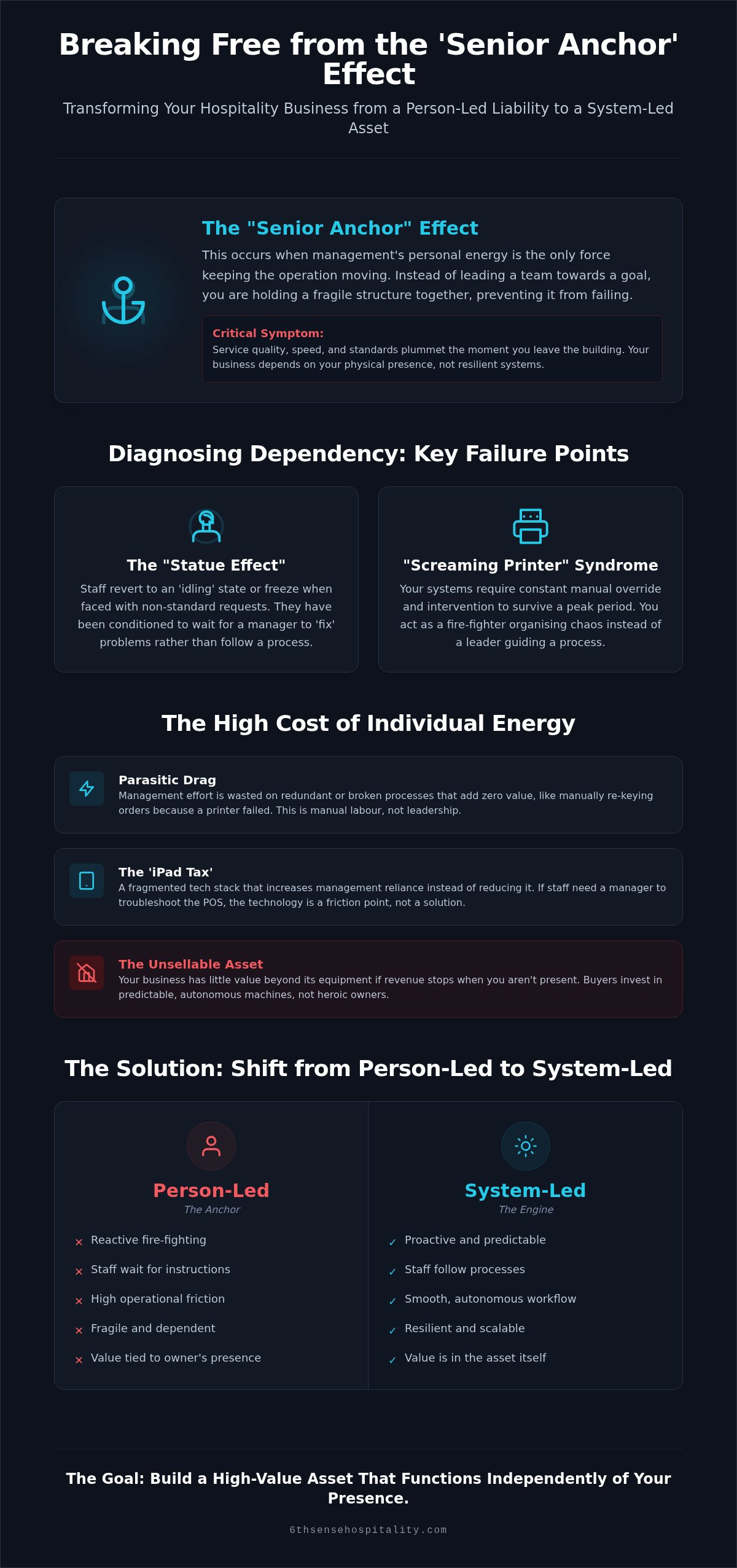
Most hospitality owners believe they are the engine of their business. They're wrong. In reality, they are the anchor. When we look at defining operational risk, we often focus on external threats or financial shifts. In a service environment, the greatest risk is usually internal. It is the "Senior Anchor" effect. This happens when management energy is the only force keeping the operation moving forward. Assessing operational reliance on management reveals a structural bottleneck where your personal willpower masks a failing machine. You aren't leading a team toward a goal; you're holding a structure together to prevent it from drifting into the rocks.
Leading involves setting a trajectory and letting systems maintain the pace. Anchoring is a static, exhausting act of intervention. This creates a dangerous shear point. Your instructions don't lead to autonomous action. Instead, they create a dependency loop where staff behaviour only aligns with your standards when you are physically present to enforce them. The connection between the "manual" and the "floor" has snapped.
Symptoms of a Management-Dependent Machine
The most visible symptom is the "Statue Effect." Walk away from the pass or the front desk for fifteen minutes. If your team reverts to an "idling" state or freezes the moment a non-standard request arrives, you have a problem. They've been trained to wait for a "fixer" rather than follow a process. You might also recognise "Screaming Printer" syndrome. This occurs when your systems require constant manual override to survive a peak period. If the ticket machine is relentless and you're the only one who can organise the chaos, your business isn't "busy." It's failing. You're a high-paid fire-fighter distracted by smoke whilst the margins evaporate.
The High Cost of Individual Energy
This dependency carries a massive "Owner Tax." It's the literal cost of your time spent fixing basic gaps that a resilient system should handle. Every hour spent smoothing over a guest complaint or re-keying data is an hour stolen from strategic growth. Worse, it turns your business into an unsellable asset. Professional buyers don't invest in "heroic owners." They buy predictable, autonomous machines. If the revenue stops when your heart isn't in the building, the business has no value beyond its equipment. You're trapped as the "chief problem solver" because you haven't built a machine that can solve its own problems. Moving from a person-led to a system-led operation is the only way to de-risk your future.
Identifying the Mechanics of Reliance and Systemic Failure
Every hospitality operation is a series of linkages. Information should flow from the guest to the staff and through the kitchen or bar with minimal resistance. When this flow breaks, it creates "Parasitic Drag." This is where management effort is wasted on redundant or broken processes that add zero value to the guest experience. You see it when a manager has to manually re-key orders or chase kitchen staff because a printer failed. This isn't leadership. It's manual labour. True operational discipline and long-term vision require systems that function without a human bridge to close the gaps.
Then there is the "iPad Tax." This occurs when your tech stack is so fragmented that it increases management reliance instead of reducing it. If your team needs a manager to troubleshoot the POS three times a night, the technology is a friction point, not a solution. When assessing operational reliance on management, you must distinguish between a "people problem" and a systemic failure. If multiple different staff members make the same mistake, the system is designed to fail. It's a mechanical flaw, not a lack of talent.
The Statue Effect: Behavioural Gaps Without Oversight
The "Statue Effect" is the psychological consequence of a management-dependent culture. In high-pressure environments, staff instructions often fail because they lack mechanical accountability. Without a system that tracks performance in real-time, staff default to a state of idling the moment senior oversight leaves the floor. They aren't inherently lazy. They've been conditioned to wait for the "Senior Anchor" to provide the next burst of energy. You can measure this by tracking service speed or table turnover when you are in the building versus when you are away. That delta is the cost of your dependency.
Operational Friction and Service Speed Bottlenecks
Map the flow of a single order. Does it move through the system on its own, or does it require management "grease" to stay on track? "Thermal Redlines" are the points where your current management structure overheats. This usually happens at peak capacity. If you find yourself jumping on the pass just to keep the kitchen from exploding, you've hit a structural redline. Adding more staff is rarely the fix. You're just adding more components to a broken machine. You need to identify where the friction sits before the whole structure shears. To get a clear view of these failure points, you can use a targeted diagnostic scan to see exactly where your operation is dragging.
Reliance vs. Resilience: A Structural Comparison
A person-led operation is a liability masquerading as a business. It relies on the variable energy of a few individuals to push through the daily grind. In contrast, a system-led operation is an engineered machine. It executes strategy through fixed processes that don't get tired, distracted, or have "bad days." When you are assessing operational reliance on management, you are essentially measuring how much of your profit is being eaten by the friction of human inconsistency. Resilience isn't about having a "great team"; it's about having a structure that makes it difficult for any team to fail.
Reliance forces stagnation. You cannot open a second location if the first one requires your heartbeat to survive. Resilience allows for scaling because the "gearbox" of the business can be replicated and installed elsewhere. Without this, your ROI is capped by your own physical limits. If your growth has stalled, it isn't a market problem. It's a structural one.
The Fragility of the Hero Manager
The "Hero Manager" is the most dangerous component in your business. They are a single point of failure. Whilst they feel like a godsend because they "get things done," they are actually a structural weakness. When a business depends on one person to save the day every shift, it operates at a permanent mechanical redline. Eventually, that component will snap. Burnout isn't a personal failing; it's a predicted outcome of a broken system. You must stop being the mechanic who fixes the engine whilst it's running. You need to become the engineer who designs a better engine.
Building the Gearbox: Systems That Execute Strategy
Operational engineering is the antidote to management fluff. It’s about creating mechanical linkages between an instruction and its execution so that staff behaviour remains consistent without oversight. This requires a shift in how you organise your daily workflows. Consider these three pillars of a resilient gearbox:
- Mechanical Accountability: Digital or physical checkpoints that flag failures before they reach the guest.
- Decentralised Data: Ensuring staff know exactly what "success" looks like without needing to ask you for permission.
- Event-Driven Processes: Workflows that trigger based on specific operational events rather than a manager's mood or memory.
If a stranger couldn't walk in and run your floor using only your written systems, you don't own a business. You own a job that you can't quit. This is the ultimate "Exit Readiness" test. If your presence is required for the value to exist, your asset value is effectively zero.
Reducing Friction: De-risking the Hospitality Operation
De-risking your operation isn't about hiring "better people." It's about fixing the machine. If your business breaks when you leave, the machine is faulty. Start by assessing operational reliance on management to identify where your energy is subsidising broken processes. You need a systematic approach to strip away the noise and rebuild the floor mechanics from the ground up. This isn't a theoretical exercise. It's an intervention designed to stop your margins from evaporating into the heat of daily chaos.
Follow these four steps to regain control of your floor:
- Step 1: Audit your tech stack for "Parasitic Drag" and redundant software.
- Step 2: Realign staff instructions using the "Statue Effect" diagnostic framework.
- Step 3: Install mechanical accountability tools that function without your oversight.
- Step 4: Conduct "Operational Stress Tests" during your busiest peak periods.
Auditing the Hospitality Tech Stack
Most hospitality tech is a trap. You pay for a "solution" that requires a manager to troubleshoot it every Friday night. This is the "iPad Tax." It turns your leaders into unpaid IT support. To calculate the ROI of your tech, measure the time spent managing the software versus the time it actually saves on the floor. If the software requires manual intervention to survive a rush, it's creating friction. It’s a component that’s dragging the engine down. You can use an iPad Tax Quick Scan to see if your digital tools are actually bleeding your margins and stealing your management's focus.
Mechanical Realignment of Staff Workflow
"Instructional Integrity" is the measure of how well your orders translate into floor behaviour. In a management-dependent system, this link is weak. Staff wait for the "Senior Anchor" to tell them what to do next. You must replace "culture coaching" with mechanical accountability. Use data-driven reports to identify service bottlenecks before they cause a structural crash. This isn't about being mean. It's about being precise. You’re building a gearbox where every part knows its role.
Fostering a culture of accountability starts with systems, not speeches. If a process is "optional," it will be ignored during a rush. You need to conduct regular "Operational Stress Tests." Watch the machine at its peak. Identify the point where the workflow shears and the manager has to jump in to "save" the service. That is your failure point. Fix the system at that redline, and you de-risk the entire operation. You're moving toward a business that executes strategy whilst you're off-site, not just whilst you're watching. This is how you build a resilient asset.
Real-time Diagnostics for Structural Integrity
Traditional hospitality consulting is a slow-moving drain on your resources. It relies on months of observation to tell you what you already feel in your gut. By the time a consultant delivers a fifty page report, your operational friction has already cost you thousands in lost margin and staff turnover. You don't need a theoretical framework. You need an immediate intervention. Assessing operational reliance on management should be as fast as checking a pressure gauge. If you can't diagnose the failure in real-time, you're just guessing whilst the machine grinds itself to pieces. High-velocity diagnostics replace vague intuition with raw data.
Most operators are too close to the engine to see the smoke. They've become accustomed to the rattling. Real-time diagnostics force you to look at the structural reality of your floor. It's about identifying where the energy is leaking before the entire system shears. You're moving from a state of chaotic overwhelm to a position of data-driven clarity. This isn't a "management style" change. It's a mechanical overhaul that prioritises systems over personality.
The €7 Diagnostic Shift
We prioritise scans over generic advice because your business doesn't have time for fluff. Generic management theories don't fix a kitchen that crashes during a Saturday rush. The 6th Sense Hospitality approach uses 60-second tools to pinpoint exact failure points. For the price of a pint, you get a data-driven report on your operational reality. The ROI of identifying a single "evaporating margin" or a "system lag" is immediate. Using the Senior Anchor Quick Scan allows you to quantify your dependency score. It shows you exactly how much your business relies on your pulse to survive. Once you see the numbers, you can begin to unshackle yourself from the floor.
Taking the Next Step Toward Operational Maturity
Operational maturity is the point where your business functions as a self-sustaining machine. It requires you to interpret your diagnostic report and make immediate structural changes. You stop being the "fixer" and start being the engineer. If the scan shows a high dependency on senior oversight, you realign the workflow. If it identifies "Parasitic Drag" in your tech, you cut the dead weight. This methodical stripping away of operational noise is what builds a high-value asset. You're no longer holding the anchor; you're steering the ship. Diagnose your management reliance with the Senior Anchor Quick Scan to see where your business is actually anchored.
Stop Anchoring and Start Engineering
Your hospitality business shouldn't be a cage that requires your pulse to stay upright. We've identified how the "Senior Anchor" effect and the "Statue Effect" are grinding your operational gears to a halt. If you can't walk away for a week without a total system crash, you don't own an asset; you own a high-stress job. It's an unsustainable way to operate that eventually leads to a mechanical snap.
The path forward requires assessing operational reliance on management with cold, hard data. Stop relying on "culture coaching" or "more staff" to fix structural redlines. Real-time diagnostics allow you to strip away the noise and build a machine that executes strategy whilst you're off-site. Used by veteran hospitality operators, our 60-second scans provide the actionable, data-driven reports you need to fix the engine for good.
It's time to stop the burnout and start the repair. You've built the structure. Now it's time to make it run on its own.
Unshackle the Anchor: Take the Senior Management Dependency Scan for €7
Frequently Asked Questions
What is the "Senior Anchor" effect in hospitality management?
The "Senior Anchor" effect occurs when the energy of a single manager is the only force preventing the operation from drifting into failure. Instead of acting as a strategic engine, the manager becomes a static weight holding the structure together. This dependency creates a massive shear point. When that individual energy is removed, the business stops moving. It's a structural failure that turns a leader into a bottleneck.
How do I know if my restaurant is too dependent on me?
You can tell your restaurant is too dependent on you if service quality fractures the moment you step off the floor. Look for the "Statue Effect" amongst your team. If staff revert to an idling state or freeze during non-standard requests without your oversight, your business is anchored. Start by assessing operational reliance on management to quantify how much your personal willpower is masking deep systemic cracks.
Can a hospitality business truly run without senior management on-site?
A resilient hospitality business can function autonomously if it's built as a system-led machine. This requires replacing manual management effort with mechanical accountability tools. You move from "fixing" problems to "engineering" solutions that trigger based on operational events. When the gearbox of the business is properly aligned, the floor executes strategy without needing a senior anchor to provide a constant burst of energy.
What is the "iPad Tax" and how does it affect my operational efficiency?
The "iPad Tax" is the hidden cost of fragmented, complex tech stacks that increase management workload instead of reducing it. If your leaders spend their shifts troubleshooting software or re-keying data across platforms, you're paying this tax. It drains operational efficiency by pulling management focus away from the guest experience. It turns your high-level operators into unpaid IT support for broken digital "solutions."
Is it possible to reduce staff instructions failing when I am away?
Reducing instruction failure requires a shift from "culture coaching" to mechanical accountability. Instructions fail when they lack a system that tracks execution in real-time. By implementing fixed processes and digital checkpoints, you create a gearbox where every part knows its role. This ensures that "what is said" is "what is done" even whilst you are off-site. It's about building a machine that makes failure difficult.
How much does an operational diagnostic scan cost?
A diagnostic scan from 6th Sense Hospitality costs €7. This fixed fee provides immediate access to digital tools like the Senior Anchor Quick Scan or the iPad Tax Quick Scan. These are 60-second assessments designed to strip away operational noise and deliver a data-driven report. It's a low-friction way for operators to identify specific pressure points without the high costs of traditional consulting fluff.
What is the difference between a hospitality consultant and a diagnostic tool?
Traditional hospitality consultants often rely on months of observation and charge high fees for generic advice. A diagnostic tool, like those offered by 6th Sense Hospitality, provides a high-velocity intervention. These 60-second scans pinpoint exact failure points in your floor mechanics immediately. You get raw data and actionable reports rather than vague theories. It's the difference between a long-term therapy session and a diagnostic mechanic.
How does operational reliance affect the sale value of my business?
High operational reliance drastically reduces your asset value. Professional buyers aren't interested in purchasing your personal energy or a "heroic" management style. They buy predictable, self-sustaining machines. If assessing operational reliance on management shows that the revenue stops when you leave, the business is effectively unsellable. Transitioning to a system-led operation is the only way to build a business that has value as a standalone asset.


