
Your hospitality business isn't failing because you lack passion. It's redlining because the mechanical friction in your operation is tearing the engine apart. You're watching profit margins evaporate despite record turnover; whilst peak hours feel less like service and more like a controlled explosion. It's an exhausting cycle of owner dependency that leaves you tethered to the floor. Identifying hospitality business stress points isn't about working harder on the fly. It's about a diagnostic intervention before the entire system suffers a terminal seize.
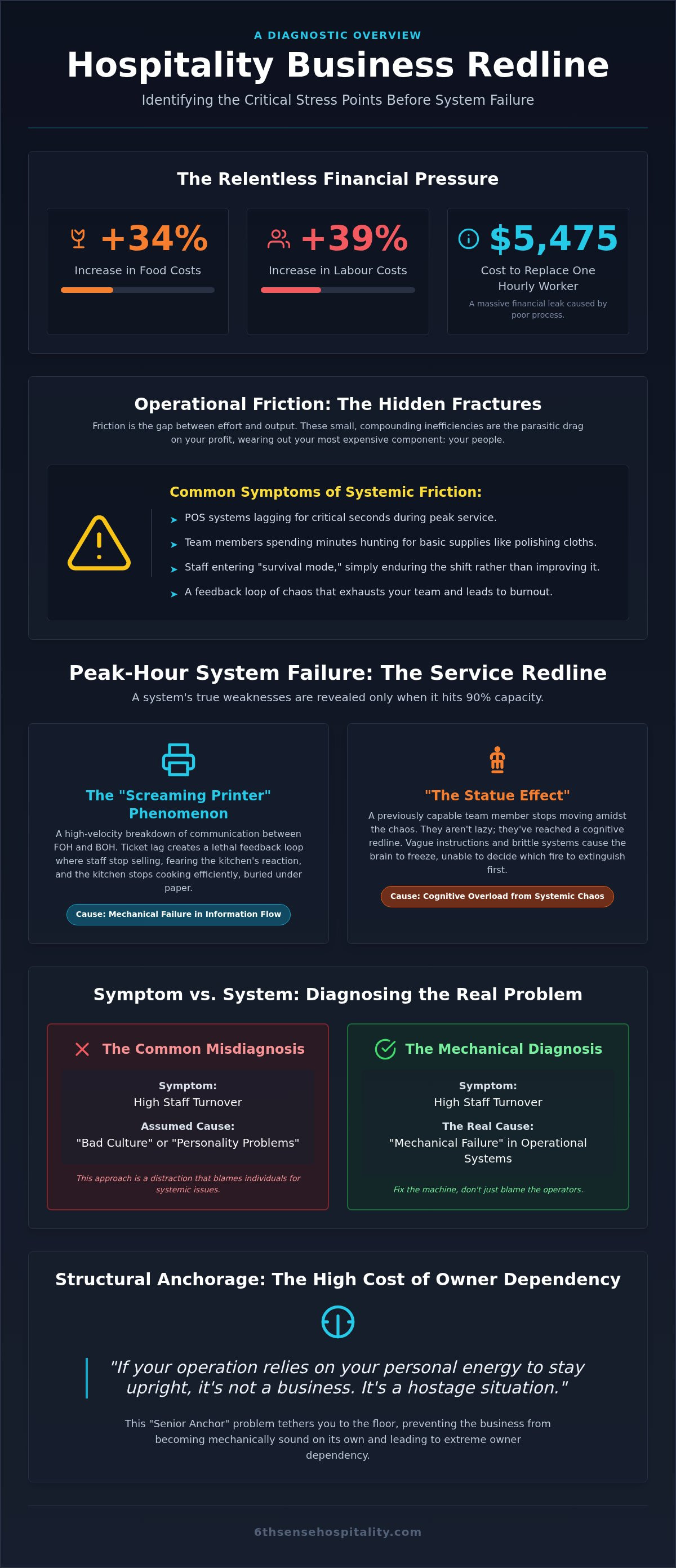
We know the pressure is relentless. With food costs up 34% and labour costs climbing by 39% compared to pre-pandemic levels, there's no room for a loose bolt in the machine. You can't afford to burn $5,475 every time an hourly worker walks out the door. This article identifies the hidden fracture lines in your kitchen and front-of-house before they lead to a systemic crash. We will preview a specific operational checklist designed to isolate bottlenecks, reduce manual management graft, and protect your bottom line with data-driven precision. It's time to stop guessing and start fixing the machine.
Key Takeaways
- Locate the hidden fracture lines in your operation by auditing specific hospitality business stress points that traditional consulting often ignores.
- Understand the mechanics of "The Statue Effect" and why your staff stop moving when the pressure of peak service hits the redline.
- Identify the invisible revenue leaks in your supply chain that cause margins to evaporate whilst you are busy focusing on the floor.
- Diagnose the "Senior Anchor" problem to reduce owner dependency and ensure the business remains mechanically sound without your constant intervention.
- Move beyond generic management advice to a high-velocity diagnostic model that fixes operational friction with data-driven clarity.
Mapping the Fracture Lines: Why Hospitality Businesses Stall
Busy is a mask. Most operators confuse a packed dining room with a healthy business. It's a lethal mistake. A business can be busy but mechanically broken. Think of a jet engine. It can spin at maximum RPM whilst the bearings are actively disintegrating. This is the reality for many in the hospitality industry. You see the movement, but you don't see the structural failure. Identifying hospitality business stress points requires you to look past the noise of the shift. It's about finding where the energy is being wasted. If your turnover is high but your bank balance is static, the machine is failing. You aren't running an operation; you're managing a crisis.
The Anatomy of Operational Friction
Friction is the gap between effort and output. You see it when a server spends three minutes hunting for a clean polishing cloth. You feel it when the POS system lags for five seconds during a Friday night rush. These aren't just minor annoyances. They are fractures. Small inefficiencies compound over time. They create a feedback loop of chaos that exhausts your team. Operational friction is the parasitic drag on your profit. It slows down every transaction and wears out your most expensive components: your people. When friction becomes the norm, your staff stop trying to fix the system. They simply try to survive the shift. This "survival mode" is the first sign that your business is beginning to redline.
Symptoms vs Systemic Failure
Traditional management advice tells you to focus on culture when staff leave. That's a distraction. High staff turnover is often a mechanical problem, not a personality one. When your systems are broken, people have to work twice as hard to get half the result. They burn out. They quit. According to 2025 benchmarking data, it costs approximately $5,475 to replace a single hourly worker. That's a massive financial leak caused by poor process. Don't blame the individuals for failing to keep up with a broken machine. If your operation relies on your personal energy to stay upright, it's not a business. It's a hostage situation. You must recognise these hospitality business stress points before they lead to a terminal seizure. The symptoms are clear: evaporating margins, systemic lag, and extreme owner dependency. If you don't address the mechanics, the machine will eventually stop. No amount of "motivation" will restart a seized engine.
The Service Redline: Identifying Peak-Hour System Failure
Peak volume is the ultimate diagnostic tool. Most hospitality systems look functional at 20% capacity. They appear organised during the mid-afternoon lull. But the truth only emerges when the dining room hits 90% and stays there. This is the service redline. It is the moment when hospitality business stress points transform from minor annoyances into systemic failures. If your operation relies on staff "working harder" to bridge the gap, you aren't managing a system. You are gambling with your reputation and your sanity.
The Screaming Printer Phenomenon
The sound of the ticket machine shouldn't trigger a panic attack. When the "Screaming Printer" starts, it signals a high-velocity breakdown of communication between the front and back of house. Ticket lag creates a lethal feedback loop. Front-of-house staff stop selling because they are terrified of the kitchen's reaction. The kitchen stops cooking efficiently because they are buried under a mountain of paper. This isn't a personnel issue. It is a mechanical failure in your information flow. To audit this, you must measure the "Reality Score" of your service. How many minutes pass between a guest ordering and the kitchen receiving the ticket? If that number fluctuates wildly during peak hours, your communication architecture is shearing under the pressure. You can isolate these failures by running a Screaming Printer Quick Scan to see exactly where the signal is getting lost.
Staff Behaviour Under Pressure
High pressure causes accountability to evaporate. We call this "The Statue Effect." It's the moment a previously capable server stops moving amongst the chaos. They aren't lazy. They've reached a cognitive redline. When instructions are vague and systems are brittle, the human brain freezes. They become statues because they no longer know which fire to put out first. This environment is the primary reason for the industry's struggle with retaining hospitality talent. The best staff won't stay in a business that feels like a perpetual emergency. They want a machine that works. If your team only follows the rules when you are standing on the floor, your structural linkages are broken. Accountability must be built into the process, not enforced by the owner's presence. Identifying these hospitality business stress points allows you to build a resilient operation that functions even when you step away from the controls. Don't wait for the next busy Saturday to find out where your machine is going to seize.
Evaporating Margins: The Financial Stress Points You Cannot See
Revenue is vanity. You can have a queue out the door and still be bleeding out on the counting table. When the till is full but the bank account is stagnant, you have a pressure leak. Identifying these invisible hospitality business stress points is a diagnostic necessity, not an accounting chore. Food costs are up 34% as of early 2026. Your margin for error has vanished. If your kitchen isn't weighing every steak and measuring every pour, you aren't running a business. You're running a charity. Every gram of waste is a drop of oil leaking from your engine. Eventually, the machine will seize.
Hidden Revenue Leakage Points
Leakage isn't intentional spending. It's hydraulic loss. It's the 'comped' round of drinks that wasn't authorised. It's the oversized garnish that costs 20p more than the menu price allows. These small leaks compound into a systemic failure. Unoptimised menus are the primary culprit. If you haven't adjusted your pricing to reflect the 39% rise in labour costs, you're paying your staff to serve customers for free. You need an Evaporating Margin Quick Scan to find where the cash is actually going. It isn't just about 'spending less'. It's about ensuring every penny of revenue results in a predictable output of profit. Stop guessing and start measuring the flow.
The iPad Tax and Tech Friction
Your tech stack is likely a parasitic drag. We call this the 'iPad Tax'. It's the collection of £50-a-month subscriptions that promised to 'revolutionise' your workflow but only added more buttons to press. Tech complexity is a friction point. If your software doesn't talk to your POS, your staff are wasting time on manual data entry. That's labour you can't afford. High-performance machinery doesn't have extra parts. It only has what is necessary for the mission. Audit your subscriptions. If a tool doesn't provide a clear, data-driven ROI, cut it. Use an iPad Tax Quick Scan to strip away the digital noise. Your goal is a lean, high-velocity operation that converts effort into cash without the friction of unnecessary 'helpful' tools. If the tech doesn't make the machine faster, it's just weight.
Structural Anchorage: The High Cost of Owner Dependency
If your business stops moving the moment you walk out the door, you don't own an asset. You own a job. A high-stress, low-security job that relies entirely on your personal energy to stay upright. This is the "Senior Anchor" problem. In a mechanically sound operation, the owner is the architect, not the engine. When you are the only one who can solve a guest complaint or authorise a supplier payment, you've created a single point of failure. This structural dependency is one of the most dangerous hospitality business stress points. It makes your business impossible to scale and even harder to sell. An investor doesn't want to buy your personal stamina; they want to buy a machine that runs itself.
The Trap of the Essential Owner
You're the first one in and the last one out. You tell yourself it's because you care more than the staff. The reality is bleaker. You haven't built the linkages necessary for autonomy. When you step onto the floor, the team stops thinking. They wait for your command. This manual effort is exhausting. It leads to systemic burnout and a mental redline that you cannot sustain. A business that requires your constant presence isn't a success; it's a hostage situation. You're trading your life for a turnover that evaporates the moment you take a day off. You need to transition from manual intervention to mechanical systems that don't require your hands on the controls every hour.
Building Operational Maturity
Operational maturity is the ability of your business to function whilst you are off-site. It requires decentralised decision-making. Your staff need a checklist for autonomy, not a direct line to your mobile. Stress-test your operation by leaving for forty-eight hours. Don't answer the phone. See what breaks. The fractures that emerge are your diagnostic roadmap. If the kitchen seizes or the front-of-house loses its rhythm, you've identified a mechanical failure in your training or your process. You can isolate these structural risks by running a Senior Anchor Quick Scan to see exactly how dependent the gears are on your personal touch. Fix the linkages now, or you'll be anchored to the floor forever. Identifying these hospitality business stress points is the only way to build a business that actually works for you, rather than the other way around. If the machine can't run without you, it's not finished yet.
The Diagnostic Intervention: Fixing the Machine Before it Crashes
Talking about your feelings won't fix a leaking margin. Traditional hospitality consulting is often just expensive therapy. It focuses on "vision" and "culture" whilst your engine is actively seizing. You don't need a life coach; you need a diagnostic mechanic. Identifying hospitality business stress points requires raw data, not a "gut feeling". If you can't measure the friction in your operation, you can't fix it. The shift from subjective observation to objective diagnostics is the difference between operational survival and a systemic crash. You need to see the machine as it actually functions, not how you hope it behaves.
Data vs Fluff: The Reality Score
A "Reality Score" is a blunt assessment. It strips away the corporate polish and reveals the hidden lag in your systems. Most operators are too close to the floor to see the smoke coming from the engine room. You need a diagnostic report that identifies specific mechanical failures. Long-term management contracts are often a waste of capital. A one-time, high-velocity scan provides the immediate clarity required to realign your processes. This isn't about "coaching" your staff to be better. It's about fixing the brittle linkages that cause them to fail in the first place. Use data to isolate the noise and focus on the mechanics of the shift.
Next Steps for the Overwhelmed Operator
You're exhausted. The list of operational failures feels terminal. But you don't fix a jet engine by looking at every bolt simultaneously. You prioritise the critical stress points. The "Quick Scan" method provides immediate clarity without the friction of a traditional audit. In sixty seconds, you can reveal years of hidden operational lag. Whether it's the "iPad Tax" bleeding your profit or the "Statue Effect" freezing your staff, you must know which fire to put out first. High-stakes problems require a low-friction starting point. Stop guessing why your business is redlining. Diagnose your operational lag with a Quick Scan for €7 and get the diagnostic roadmap you need to stop the bleed. It is time to stop surviving the shift and start fixing the machine.
Stop Redlining and Start Fixing the Machine
Redlining during peak hours isn't a badge of honour. It is a warning light on your dashboard that the gears are grinding. You've seen the fracture lines; from the Screaming Printer causing ticket lag to the Senior Anchor of owner dependency. These aren't just quirks of the trade. They are mechanical failures that bleed your profit and exhaust your team. Identifying hospitality business stress points is the first step toward reclaiming your time and protecting your bottom line from systemic collapse.
You don't need a motivational speech. You need a diagnostic intervention that cuts through the noise. For a €7 one-time fee, you can strip away the consulting fluff and get a clear, data-driven reality score for your operation. Run a 60-second diagnostic scan to find your fracture lines and stop the drift before the machine seizes. The business is already in your hands. It's time to make it run with precision.
Frequently Asked Questions
What are the most common hospitality business stress points?
Common hospitality business stress points include systemic lag during peak hours, evaporating margins due to unmeasured waste, and extreme owner dependency. These aren't personal failings; they're mechanical fractures. You see them when the "Screaming Printer" creates a feedback loop of chaos or when "The Statue Effect" freezes your team. These points represent the gap between your manual effort and your actual profit output.
How can I tell if my restaurant is redlining?
Your restaurant is redlining when output drops as pressure increases. It's the moment the kitchen stops being efficient and starts merely surviving the shift. You'll see ticket times climb whilst staff movement becomes erratic. If adding more customers to the room causes the system to seize rather than produce more revenue, you've hit the mechanical limit of your current operational architecture.
What is the "Statue Effect" in hospitality staff?
The "Statue Effect" is a cognitive redline where staff stop moving because they're overwhelmed by broken systems. It's a structural failure of accountability and instruction. When the machine is too complex or the signals are too noisy, the human brain freezes. It's a common symptom amongst hospitality business stress points that indicates your processes are shearing under high-volume pressure.
How much does operational inefficiency cost a typical business?
Operational inefficiency is a parasitic drain on your bank balance. Replacing a single hourly worker costs approximately $5,475 in recruitment and training. With food costs up 34% and labour costs up 39% since the pandemic, you can't afford a loose bolt. Every second of system lag or gram of kitchen waste is cash leaking directly out of your engine every day.
Can a diagnostic tool replace a hospitality consultant?
A diagnostic tool provides a blunt reality score without the corporate fluff of a traditional consultant. Consultants often push long-term contracts and theoretical advice. A 60-second Quick Scan gives you a raw, data-driven assessment for a €7 one-time fee. It's a high-velocity intervention designed to find the fracture lines in your machine so you can fix the mechanics yourself.
What is the "iPad Tax" in the hospitality industry?
The "iPad Tax" refers to the digital weight of unnecessary software subscriptions. These tools often promise to revolutionise your workflow but actually create more manual graft and tech friction. If a subscription doesn't provide a clear, measurable ROI or talk to your other systems, it's just a parasitic drag on your margin. It's time to strip the tech stack to its essentials.
How do I reduce owner dependency in my restaurant?
You reduce owner dependency by building mechanical systems that function whilst you're off-site. This requires decentralised decision-making and clear structural linkages. If your team only follows the rules when you're on the floor, you've got a "Senior Anchor" problem. You must transition from being the engine to being the architect of the machine. Systems must replace your personal energy.
What happens if I ignore these operational stress points?
Ignoring these points leads to a systemic crash. Your profit margins will continue to evaporate whilst your personal exhaustion hits a terminal limit. Eventually, the friction becomes too great and the machine seizes. You'll be left with a business that is impossible to scale, hard to sell, and a burden to operate. The result is a total collapse of both profit and sanity.


