
HOSPITALITY INSIGHTS · OPERATIONS & FLOW
Part of the Operations & Flow series — examining where movement, information, decision-making and capacity begin to break down when hospitality operations come under load.
Imagine walking into a high-end restaurant kitchen at 8:15 PM on a Saturday.
The ticket printer is shrieking.
The pass is piled high with plates going cold.
The chef is yelling.
Servers are standing between competing priorities, unsure which fire to put out first.
And somewhere in the middle of it all, a manager is running across the floor because somebody needs authorization to comp a dessert.
Most operators look at that room and think:
We need to react faster.
That's where the mistake begins.
When an airplane encounters severe turbulence at 30,000 feet, the pilot doesn't pull out the owner's manual and start inventing safety protocols.
Those protocols were written, tested and drilled on the ground — long before anybody needed them.
Yet in hospitality, we routinely expect people to invent policy in the middle of a hurricane.
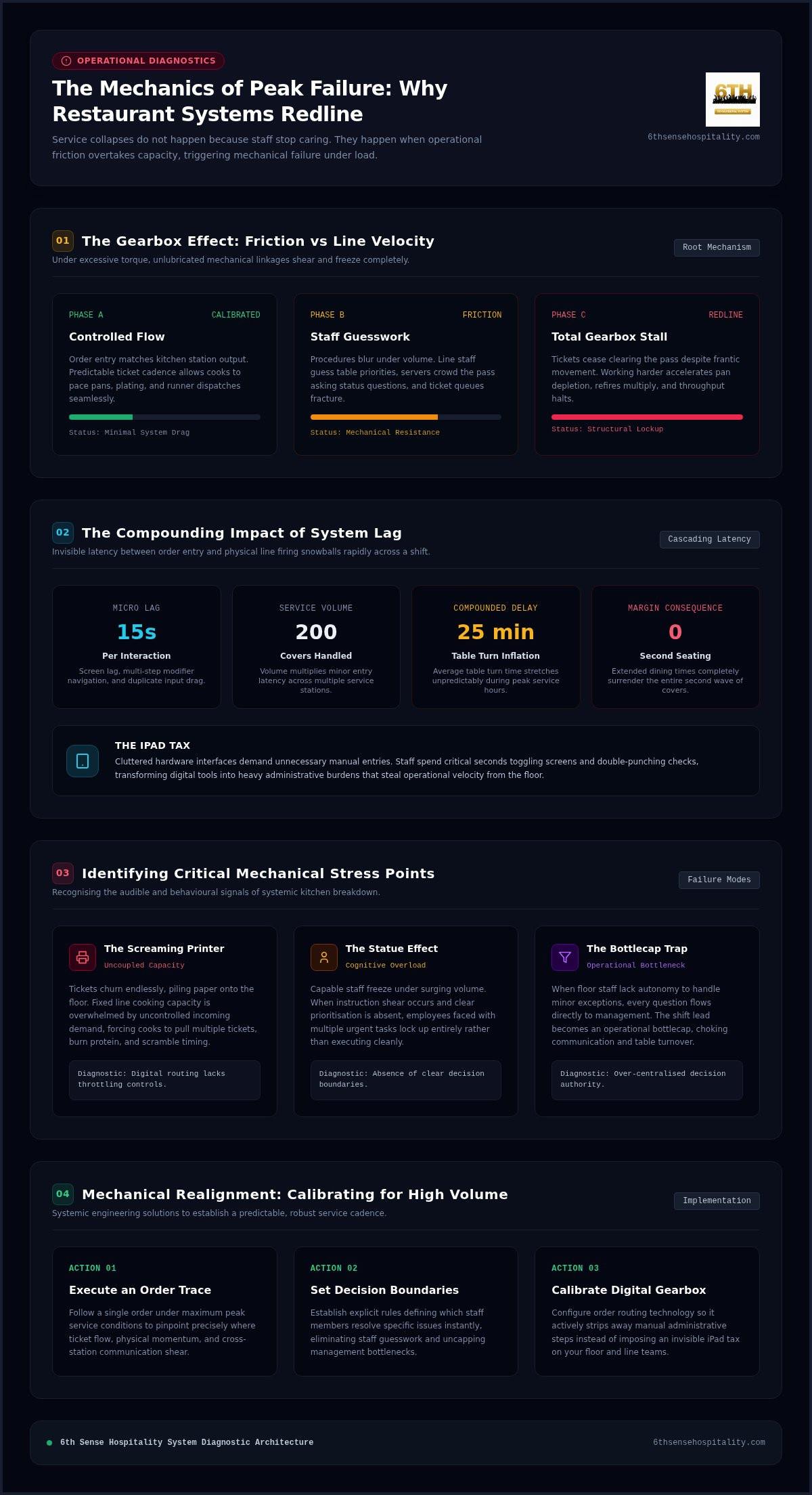
The Decision Queue — And Why Good Staff Turn Into Statues
Staff don't always hesitate because they are lazy, inexperienced or incompetent.
Sometimes they hesitate because the operation hasn't told them where their authority begins and ends.
A guest complains about an overcooked steak.
A table has been waiting 20 minutes for drinks.
A bill needs a small correction.
A family wants to move tables.
One problem becomes two.
Two become five.
And if an employee has to find a manager every single time one of those decisions appears, the steak is no longer the problem.
Your business has created a decision queue.
Think of the floor like a junction.
As long as everybody knows who has priority, traffic moves.
Remove the rules and suddenly every light turns yellow.
People slow down.
They look at each other.
They wait.
And eventually everything stops.
That's what I call the Statue Effect.
Capable, intelligent people can suddenly appear to freeze because the system has given them competing priorities without telling them which one wins.
The solution isn't shouting:
“Come on! Move faster!”
You set the decision boundaries before the pressure arrives.
You don't wait for the fire to decide where the extinguisher goes.
A supervisor should know — without searching for you, without an override key and without another meeting — what they are authorised to resolve.
That might include a defined financial limit for resolving a guest complaint immediately.
The exact amount isn't the important part.
The important part is this:
- •The decision was already made on a calm morning.
- •What happens when ticket times cross your acceptable limit?
- •Who can reseat a table?
- •When does the kitchen stop accepting complex modifications?
- •Who gets priority when food running, guest complaints and payment requests collide?
If you're inventing those answers during the Saturday-night rush, you're already late.
The iPad Tax
Then we add technology.
We buy it because it promises speed.
But sometimes technology behaves like a well-meaning assistant who insists on wrapping every package in three layers of bubble wrap before allowing it out of the building.
Watch a server modify one simple dish on your POS.
◆How many taps?
◆How many screens?
◆How many confirmation boxes?
◆How many times does somebody enter information the system already knows?
Now multiply those unnecessary seconds by every modification, every server, every table and every peak service.
I call that the iPad Tax.
It's the operational tax you pay in lost seconds and fractured attention because the technology that was supposed to remove friction has inserted itself between the guest, the floor and production.
And then we reach the kitchen.
The Screaming Printer
Your POS and kitchen display systems are supposed to support the physical choreography of the line.
But imagine your digital system releasing 40 orders into a kitchen that can physically absorb only 20 at that moment.
The software hasn't expanded your capacity.
It has simply delivered the traffic jam to the kitchen faster.
Tickets keep coming.
The rail fills.
Sequence starts disappearing.
Someone pulls a ticket forward.
Another order gets pushed backwards.
A server asks where Table 14 is.
Another asks about Table 8.
The printer keeps going.
And now everybody can hear the problem.
That's the Screaming Printer.
But here's the important part.
The printer isn't the failure.
It's the signal.
Just like the warning light on a dashboard isn't what damaged the engine, the screaming printer is telling you that something upstream has already moved outside its operating range.
And that's where the temperature needs to come back down.
Because when everything is screaming at you, everything starts looking like the problem.
It isn't.
Find the First Break
Peak service will always create pressure.
The objective of a strong operation isn't to eliminate pressure.
It's to build an operation capable of carrying the load.
That requires clear decision boundaries, clean order routing, visible capacity limits and a team that knows the next move without waiting for somebody else to decide.
But before you start changing everything, you need to know where the load is actually bending the operation.
That's the purpose of the Peak Hour Load Scan.
Think of it like stepping onto a weighing machine.
The scale doesn't make you lose weight.
It doesn't prescribe the diet.
It doesn't do the work.
It gives you a measurement you can act on.
The Peak Hour Load Scan looks for the points where capacity, routing and decision flow begin to distort under load — before all of those individual symptoms merge into what everybody simply calls:
“A bad shift.”
Because the printer isn't necessarily the problem.
The kitchen isn't necessarily the problem.
The POS isn't necessarily the problem.
And the employee standing still isn't necessarily the problem.
They're signals.
The question is:
What happened before them?
That's Signal Mapping.
Good operations don't come from reacting faster.
They come from seeing sooner.
The Rush Isn't Where the Failure Starts
By the time the printer is screaming, the pass is backing up and everybody is moving faster, you're already looking at the consequences.
The first break happened earlier.
That's the moment that matters.
The Peak Hour Stabilizer is built for that moment — while the shift is still moving and there's still time to protect the sequence before pressure becomes recovery.
SEE WHERE THE SHIFT STARTS TO BREAK →
Article by
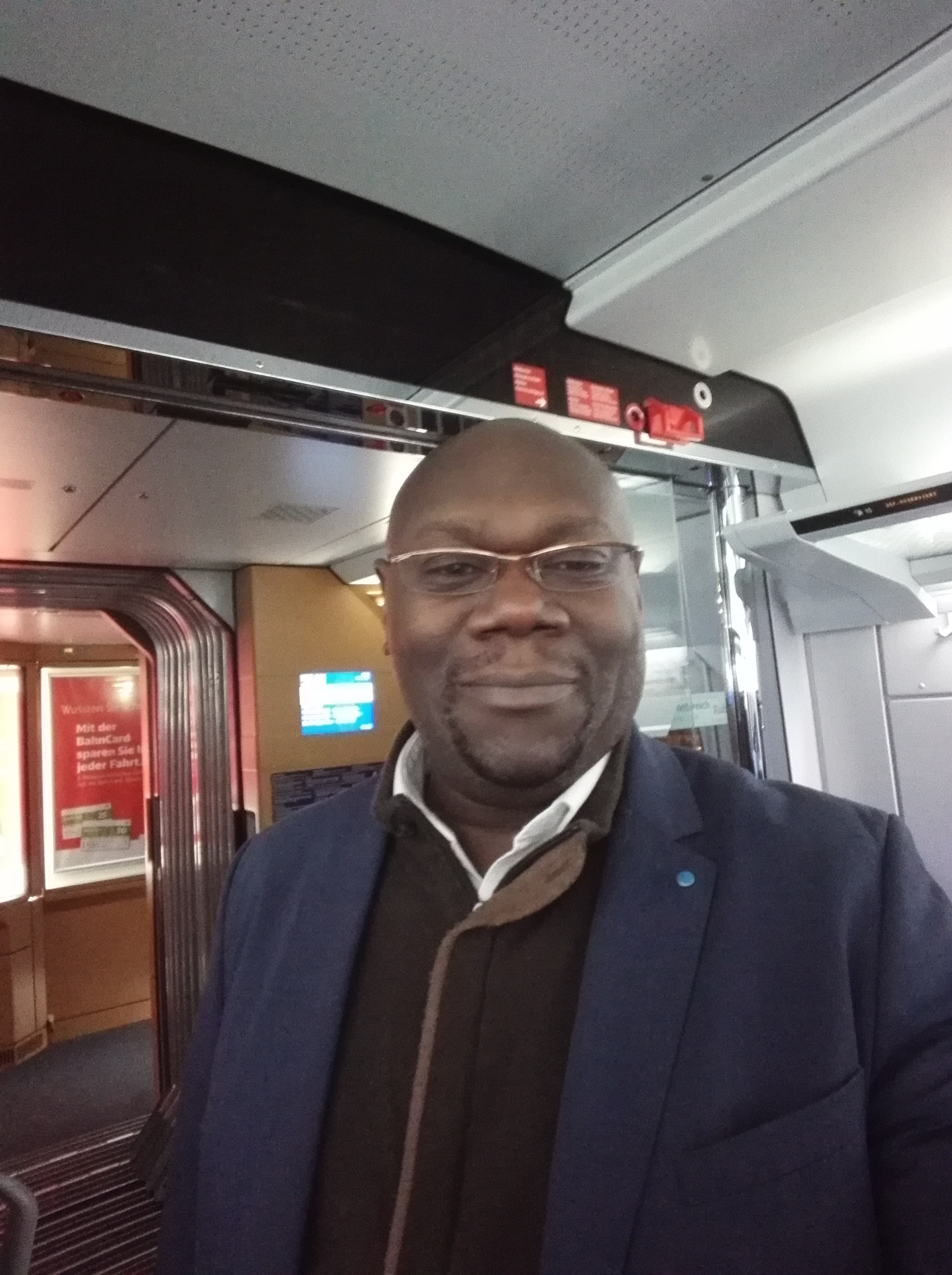
Amos J. Amolo
Amos Jactone Amolo is the founder of 6th Sense Hospitality and an Operations System Designer with more than 30 years of experience across food & beverage, live events, catering and venue operations. He still actively owns and operates hospitality and event businesses, so his observations are not based on what the industry used to look like. They are being tested on the floor today.
His perspective was built — and continues to be tested — in live operating environments where decisions happen in real time. He watches what changes when an operation comes under pressure: where timing slips, information stops moving, responsibility becomes unclear and people begin compensating for a system that is no longer helping them.
Just as importantly, he watches the customer. Changing drinking habits, new expectations around food, shorter attention spans and the increasingly visual way guests make buying decisions are already changing how hospitality needs to operate.
That thinking forms the foundation of 6th Sense Hospitality: look beyond the obvious symptom and find where people, process, technology, money and decision-making have stopped working together.
His core philosophy is simple:
“If your team starts to guess, the money has already left the building.”
Through 6th Sense Hospitality, Amos develops practical diagnostics and operational systems that help operators see what is actually happening inside their businesses — before workarounds become accepted as normal.
Not theory. Still operating. Still observing. Still testing what actually works.
Disclaimer
The content published by 6th Sense Hospitality is provided for informational and educational purposes and reflects practical hospitality experience and operational analysis. It is not intended as legal, financial, tax, HR, or other professional advice. Business circumstances vary, and readers should seek appropriate professional advice where necessary.


